Standard Equivalent Air Leak Rate Conversions for Sealed Commercial Pouch Cells
Standard air equivalent leak conversions transform empirical helium mass spectrometer readings into precise air ingress and solvent loss metrics for pouch cells.
Seam
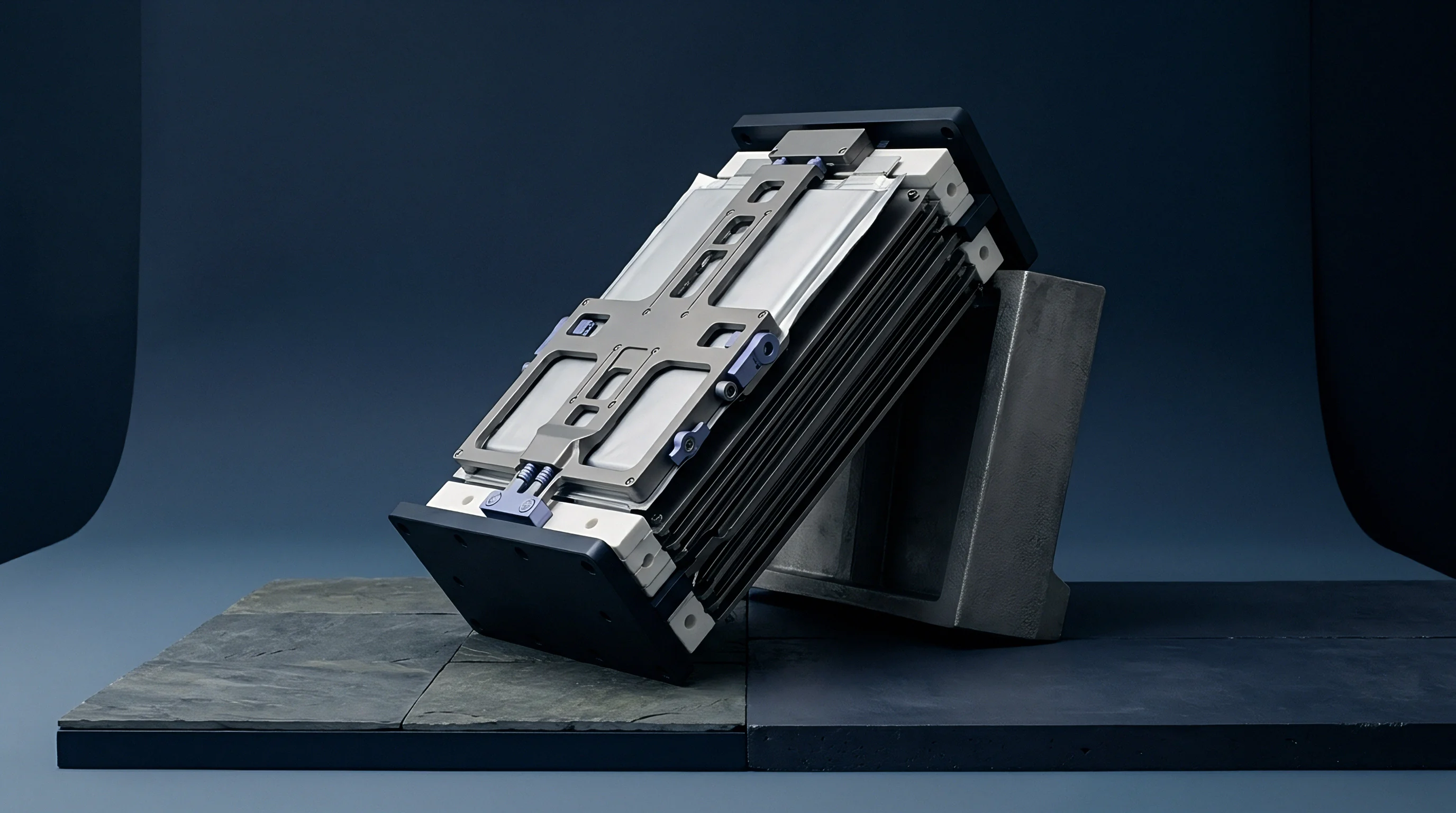
Polymer layer thermal bonding forms the primary barrier against atmospheric ingress in flexible lithium-ion enclosures. Pouch cells rely on multi-layer aluminum laminate structures joined by heat sealing along three or four perimeter flanges. The integrity of these heat-sealed boundaries dictates whether the active electrochemical stack inside remains isolated from ambient moisture and oxygen over a ten-year operational life.

Perimeter Seal Morphology and Leak Pathways
Flexible pouch enclosures utilize an aluminum laminate consisting of an outer polyamide protection layer, a core aluminum barrier foil, and an inner heat-sealable polyolefin film. Thermal sealing applies heat and pressure across opposing jaw faces to melt the inner polyolefin layer ~ typically polypropylene or polyethylene ~ causing polymer chains to interdiffuse across the interface. Channel breaches across this boundary arise primarily from process variations or surface contaminants present during bonding.
Tab seals present elevated risk. At the terminal regions, metal tabs coated with functionalized polyolefin tape pass through the perimeter seal, creating a tri-material junction between copper or aluminum metal, tab film, and seal film where thermal expansion mismatch can induce micro-voids.
Sealing temperature uniformities across thermal jaws prevent localized micro-channels from forming during pouch enclosure sealing.
Defect geometry inside sealed seams varies widely depending on how the breach formed. Micro-capillary channels left behind by trapped volatile particulates exhibit roughly circular cross-sections, whereas interfacial delaminations along tab metal surfaces form flattened, high-aspect-ratio planar leaks. These geometry differences alter how gases flow through breaches, making direct physical measurement of channel dimensions impractical.
Quality assurance relies instead on measuring gas throughput under calibrated pressure differentials to quantify overall seal tightness.

Defect Classifications in Ultrasonic and Thermal Welding
Process variations during thermal sealing generate two distinct categories of channel breaches that admit gases into the active enclosure volume. Permeation occurs homogeneously through the bulk polyolefin material, governed by polymer solubility and diffusivity constants. Pinholes and capillary defects occur non-homogeneously where local bonding failed completely.
- Thermal Seal Wrinkling arises when uneven heat distribution across sealing jaws causes localized polymer gathering along the inner flange.
- Particulate Contamination Traps occur when active material dust or severed current collector foil fragments lodge across the sealing band.
- Polyolefin Layer Thinning results from excessive jaw clamping force or elevated dwell time during heat sealing.
- Tab Primer Delamination takes place along the metallic current collector tab transition where functionalized polyolefin surfactant coatings fail to bond.
Minor inner seal margin swelling during formation cycling often reflects normal wetting rather than seal boundary degradation.
Flux
Gas transport through micro-capillaries follows physical kinetics governed by the ratio of gas molecular mean free path to physical channel diameter. Understanding these transport regimes is necessary to accurately convert empirical test measurements into standardized leakage values.
Knudsen Number Criteria and Transport Regimes
Fluid dynamics in micro-breaches operate within three distinct flow categories defined by the dimensionless Knudsen ratio. The Knudsen number (Kn) compares the mean free path (λ) of the gas molecules to the characteristic dimension (d) of the leak path, expressed as Kn = λ / d. When the channel diameter is significantly larger than the mean free path ($Kn
When the Knudsen number exceeds unity (Kn > 1.0), the mean free path exceeds the channel diameter. Gas molecules collide almost exclusively with the internal channel walls rather than with one another, defining the molecular flow regime typical of micro-defects smaller than one hundred nanometers or leaks operating under high vacuum conditions.
Between these boundary conditions ($0.01
Viscous Laminar Equations for Capillary Leaks
When breach channel diameter exceeds one micrometer, gas molecules collide primarily with each other rather than with the interior wall. Poiseuille’s law governs viscous laminar transport through circular micro-channels. The volumetric leak rate (Qvisc) depends inversely on dynamic viscosity (μ) and directly on the square of supply pressure, expressed as:
Qvisc = fracπ d4128 μ L · fracPu2 – Pd22 P0
Where d represents capillary diameter, L represents channel seal length, Pu is absolute upstream pressure, Pd is absolute downstream pressure, and P0 is baseline reference pressure. Because viscous flow depends inversely on dynamic viscosity, gases with lower viscosity flow faster through a given leak path under identical pressure conditions.
| Gas Species | Molar Mass (g/mol) | Dynamic Viscosity (µPa·s) | Mean Free Path at 1 bar (nm) | Viscous Ratio relative to Air | Molecular Ratio relative to Air |
|---|---|---|---|---|---|
| Helium (He) | 4.003 | 19.6 | 192 | 0.929 | 2.690 |
| Dry Air | 28.970 | 18.2 | 67 | 1.000 | 1.000 |
| Nitrogen (N2) | 28.013 | 17.6 | 66 | 1.034 | 1.017 |
| Water Vapor (H2O) | 18.015 | 10.1 | 42 | 1.802 | 1.268 |
| Dimethyl Carbonate (DMC) | 90.080 | 9.5 | 22 | 1.916 | 0.567 |
In molecular flow, transport rate (Qmol) depends on gas molar mass (M) and absolute temperature (T), completely independent of dynamic viscosity. Effusion equations govern molecular transport:
Qmol = frac16 sqrtfrac2 π R TM · fracd3L · fracPu – PdP0
The molecular flow rate varies inversely with the square root of molar mass. Helium (M = 4.003 g/mol) traverses a molecular breach roughly 2.69 times faster than air (M = 28.97 g/mol) under identical partial pressure gradients. Transition flow modeling yields conservative tightness targets whenever micro-channel geometry remains unmapped.
Transit
Tracer gas measurements provide the empirical baseline for quantifying containment integrity across production lots. Testing sealed pouch cells requires detection tools capable of isolating helium leak rates down to 10-10 Pa·m3/s. Standard equivalent air leak rate (Lstd) conversions transform these raw tracer readings into real-world atmospheric air ingress and solvent egress metrics.
What Mass Transport Mechanism Dominates Helium Tracer Tests?
Vacuum chamber testing places the sealed cell under external pressures below ten Pascals while monitoring total tracer accumulation through a tuned mass spectrometer. Under hard vacuum, the pressure differential across any pouch seal defect matches internal cell pressure, typically between eighty and one hundred twenty kilopascals absolute depending on electrolyte vapor pressure and cell state of charge. Because helium molecules are small and move rapidly, molecular flow dominates tracer transport through sub-micron seal defects during vacuum testing.
Helium leak testing conducted at twenty degrees Celsius with a one bar differential detects breach channels down to one hundredth of a micrometer.
Gross leaks present a distinct challenge during high-vacuum testing. If a pouch seal contains a breach larger than ten micrometers, tracer gas rapidly evacuates during initial vacuum chamber pump-down before the mass spectrometer sampling valve opens. This pre-evacuation depletion produces a false-pass reading on damaged cells.
Production verification systems combine absolute pressure decay screening with mass spectrometry to capture both macro-defects and micro-capillaries.

Stepwise Vacuum Chamber Calibration Procedure
Accurate conversion demands strict adherence to instrument zeroing and gross leak screening sequences prior to quantitative record keeping. Operational procedures must maintain calibrated reference leaks connected directly to the test chamber manifold.
- Inspect the test cell exterior for liquid electrolyte residual films that pollute high-vacuum test chambers.
- Place the pouch cell into the rigid vacuum chamber and engage the pneumatic sealing clamp.
- Evacuate the test chamber volume to thirty Pascals absolute using a dry scroll vacuum pump.
- Measure pressure accumulation rate over five seconds to detect macro-defects exceeding 10-3 Pa·m3/s.
- Open the mass spectrometer inlet valve to analyze tracer gas concentration in the chamber background flow.
- Subtract residual background helium signal from the peak measured signal to obtain the net measured tracer leak rate.
Standard purchase specifications under ISO 20485 Annex C modify testing obligations by transferring calibration audit responsibility to the cell manufacturer.


Arithmetic
Converting empirical helium tracer leakage into standard equivalent air leakage involves balancing viscous and molecular flow equations. Standard Equivalent Air Leak Rate (Lstd) represents dry air flow at twenty degrees Celsius passing from an upstream pressure of one atmosphere (101.325 kPa) to a downstream pressure below one hundred Pascals. Converting tracer data to Lstd isolates cell seal geometry from test gas artifacts.

Worked Conversion for Commercial Pouch Cells
Consider a fifty-ampere-hour pouch cell evaluated under a tracer gas test chamber pressure of one hundred kilopascals, with an empirical helium measurement (QHe) of 2.5 × 10⁻⁷ mbar·L/s recorded under hard vacuum (Pd ≈ 0) against a reference dry air baseline and a sixty percent helium tracer concentration (c = 0.60) within the internal cell headspace.
First, calculate the true pure-helium leak rate (QHe,100%) by adjusting for tracer gas dilution within the cell enclosure:
QHe,100% = fracQHec = frac2.5 × 10-70.60 = 4.17 × 10⁻⁷ mbar·L/s
Next, determine the active flow regime inside the micro-channel. For leak rates around 10-7 mbar·L/s, fluid transport operates within the Knudsen transition regime. Applying the unified Santeler conversion model calculates standard equivalent air leak rate by combining molecular and viscous components:
Lstd = QHe,100% · left · left(1 + fracBParight)-1
Where B represents capillary geometric constants and Pa is mean pressure. For predominantly molecular flow paths (Kn > 1.0), the viscous term drops out, simplifying the conversion ratio to pure molecular effusion rates:
Lstd = QHe,100% · sqrtfracMHeMair = 4.17 × 10⁻⁷ · sqrtfrac4.00328.970 = 4.17 × 10-7 · 0.372 = 1.55 × 10⁻⁷ mbar·L/s
Compliance with ASTM E413 standard conversion formulas prevents false acceptance of pouch cells carrying hidden capillary flaws.
Under viscous laminar conditions ($Kn
Lstd = QHe,100% · fracμHeμair = 4.17 × 10⁻⁷ · frac19.618.2 = 4.17 × 10-7 · 1.077 = 4.49 × 10⁻⁷ mbar·L/s
| Measured Helium Leak Rate (mbar·L/s) | Tracer Gas Concentration (%) | Dominant Flow Regime | Calculated Air Equivalent L_std (mbar·L/s) | Calculated Air Equivalent L_std (Pa·m³/s) |
|---|---|---|---|---|
| 1.0 × 10⁻⁴ | 100 | Viscous Laminar | 1.08 × 10⁻⁴ | 1.08 × 10⁻⁵ |
| 5.0 × 10⁻⁶ | 100 | Knudsen Transition | 3.12 × 10⁻⁶ | 3.12 × 10⁻⁷ |
| 2.5 × 10⁻⁷ | 60 | Molecular Effusion | 1.55 × 10⁻⁷ | 1.55 × 10⁻⁸ |
| 1.0 × 10⁻⁸ | 100 | Molecular Effusion | 3.72 × 10⁻⁹ | 3.72 × 10⁻¹⁰ |
Temperature and Pressure Differential Corrections
Standard equivalent conditions specify a baseline temperature of two hundred ninety-three Kelvin and an absolute supply pressure of one atmosphere. Test environments operating at elevated temperatures alter gas dynamic viscosity and molecular thermal velocity: higher temperatures increase dynamic viscosity, reducing viscous volumetric flow rates while increasing molecular velocity.
Engineering teams must evaluate qualification datasets against converted Lstd baselines before confirming lot compliance. Quality audits verify compliance using converted figures.
- Flow Regime Identification verifies whether Knudsen number values fall below one hundredth or exceed unity before selecting conversion formulas.
- Tracer Concentration Normalization divides the measured mass spectrometer output by the fractional helium concentration within the test enclosure.
- Viscosity Dynamic Adjustment accounts for temperature-dependent variations in gas viscosity ratios across the operational temperature range.
- Delta Pressure Quadratic Calculation applies upstream and downstream squared pressure differences when laminar viscous transport dominates the breach.
Failing to account for gas molecular dynamics understates actual moisture ingress rates, leading to unpredicted field performance degradation and severe warranty liabilities.


Ledger
Acceptance thresholds for seal tightness directly govern long-term storage viability and field warranty exposure. Lithium-ion pouch cells carry strictly limited tolerances for ambient moisture accumulation and organic solvent loss. Specifying leak thresholds requires mapping standard equivalent air leak rates (Lstd) to total mass transfer over multi-year warranty periods.
Moisture Ingress and Electrolyte Degradation Limits
Water entering through seal breaches reacts rapidly with lithium hexafluorophosphate salt to generate hydrofluoric acid, which attacks the cathode active material structure, dissolves transition metals like manganese and nickel, and degrades the solid electrolyte interphase on graphite anodes. Maximum allowable moisture contamination across cell operating lifespan is generally capped at twenty parts per million by weight.
For a typical pouch cell containing fifty grams of liquid organic electrolyte, twenty parts per million corresponds to a total allowable water accumulation of one milligram. Water vapor ingress rate (mH2O) correlates directly with standard equivalent air leak rate (Lstd) and ambient relative humidity (RH), expressed as:
mH2O = Lstd · fracMH2OMair · fracPH2O,sat · RHPatm · Δ t
Where PH2O,sat represents saturation water vapor pressure at storage temperature. To keep total water ingress below one milligram over a ten-year storage period at twenty-five degrees Celsius and sixty percent relative humidity, the maximum permissible standard equivalent air leak rate (Lstd) must not exceed 3.2 × 10⁻⁷ mbar·L/s.
Solvent Vapor Evaporation and Capacity Decay
Organic carbonates escape through micro-capillaries over extended storage periods, driving up internal cell resistance. Low-boiling solvents like dimethyl carbonate (DMC) and ethyl methyl carbonate (EMC) exert substantial vapor partial pressures inside sealed cells.
| Standard Air Leak Rate L_std (mbar·L/s) | 5-Year Water Ingress (mg) | Electrolyte H2O Concentration Increase (ppm) | 5-Year Solvent Weight Loss (mg) | Storage Capacity Loss Impact |
|---|---|---|---|---|
| 1.0 × 10⁻⁵ | 31.20 | 624 | 142.0 | Severe failure due to HF corrosion and dry-out |
| 1.0 × 10⁻⁶ | 3.12 | 62 | 14.2 | Elevated impedance and severe capacity fade |
| 3.2 × 10⁻⁷ | 1.00 | 20 | 4.5 | Acceptable threshold for 10-year lifespan |
| 1.0 × 10⁻⁸ | 0.03 | 1 | 0.1 | Negligible degradation from seal leakage |
Atmospheric moisture entering through micro-capillaries breaks down lithium salts and releases corrosive hydrofluoric acid inside sealed cells.
Establishing purchase contracts around rigorous tracer leak conversions protects pack integrators from premature field failures. Standard equivalent air leak conversion models bridge the gap between bench testing and real-world environmental exposure. Proper conversion from measured tracer gas leakage to standard equivalent air leak rates allows procurement teams to enforce strict seal tightness thresholds before cell packs ship.