Auditing Freight Forwarder Risk in Non Compliant Dangerous Goods Cargo Acceptance
Auditing freight forwarder dangerous goods acceptance requires validating UN 38.3.5 test summaries, 30 percent state of charge limits, and packaging integrity.


Dock
Receiving bays at air cargo facilities serve as the primary filter keeping uncertified dangerous goods out of active transport. When dangerous freight reaches a forwarder’s hub, ground staff run acceptance checks to confirm packaging integrity and hazard labels before loading anything onto a plane or vessel. Regulations for lithium batteries ~ specifically UN 3480 for standalone cells and UN 3481 for cells packed with or contained in equipment ~ set strict packaging standards, but audits frequently show that intake staff loosen these checks during peak hours when the pressure to move freight builds up.
Damaged packaging is often the clearest indicator that non-compliant cargo was accepted. Under Section 5 and Packing Instruction 965 of the International Air Transport Association Dangerous Goods Regulations, outer containers for lithium ion cells must meet UN specifications, typically UN 4G or UN 4GV fibreboard boxes. These packages are required to survive a 1.2-meter drop test in any orientation without cell movement, damage, or leakage.
Despite this, ground crews frequently accept incoming pallets showing crushed corners, moisture damage, or split seams ~ putting the shipment at risk of fire and exposing the forwarder to regulatory penalties from civil aviation authorities.

Cargo Terminal Intake Dynamics
Intake checks rely on standardized paperwork and physical labels to validate dangerous goods shipments. Ground handling staff cross-check package labels against the Shipper’s Declaration for Dangerous Goods. Every box of UN 3480 batteries needs a Class 9 Miscellaneous Dangerous Goods label, a Cargo Aircraft Only handling label, and a Lithium Battery Mark showing the UN number alongside a valid emergency telephone number.
In practice, audits regularly catch accepted shipments with missing emergency numbers, covered labels, or non-compliant mark dimensions.
Airlines reject visible outer damage at transfer, but initial acceptance at the forwarder counter falls on warehouse staff who rarely have training in battery chemistry. Intake counters often handle mixed pallets where lithium batteries are staged alongside heavy machinery parts. Even though air freight rules mandate strict physical separation between dangerous goods and general cargo, ground audits consistently find UN 3480 boxes stacked under heavy non-hazardous freight, where turbulence can cause severe structural compression during flight.
Non-compliant outer box orientation arrows signal deeper structural packaging oversights inside the pallet.

Physical Packaging Integrity and Label Verification
Packaging integrity also depends on how cells are arranged inside the UN 4G outer box. Individual cells must be isolated using non-conductive inner sleeves or blister packs to prevent terminal short circuits. Audit routines check whether intake inspectors look for box bulging or smell for electrolyte leakage.
Swollen packaging indicates thermal stress, internal short circuits, or gas generation inside pouch or prismatic cells. Letting a bulging box reach the apron violates basic transport safety rules as well as dangerous goods regulations.
Label checks must account for contrast, placement, and durability. Wrap-around labels placed across box seams or hidden under layers of stretch film fail regulatory standards, which require markings to remain legible after exposure to outdoor weather. Auditors sample packages on accepted pallets to ensure hazard symbols and text will not smear or rub off from routine handling and moisture.
| Transport Mode | Regulatory Framework | Package Parameter | Inspection Benchmark | Rejection Trigger |
|---|---|---|---|---|
| Air Freight | IATA DGR PI 965 | UN 4G Outer Packaging | UN specification mark present, structural rigidity intact | Crushed corners, moisture damage, missing UN specification code |
| Air Freight | IATA DGR Section 10 | Hazard Labeling | Class 9 label and Cargo Aircraft Only label adjacent | Obscured labels, missing emergency contact number on mark |
| Ocean Freight | IMDG Code SP 310 | Container Stowing | Segregation from combustible materials, structural bracing | Co-loaded with organic peroxides, unsecured pallet shifting |
| Ocean Freight | IMDG Code Section 5.4 | Container Markings | Large hazard placards on all four container walls | Missing placards, mismatched UN numbers on container exterior |
Forwarders frequently write off scuffed outer cartons or omitted emergency numbers as minor administrative errors rather than legitimate triggers for rejecting freight at the intake counter.


Manifest
Paperwork verification forms the legal basis of dangerous goods compliance long before freight reaches a ship or apron. Any lithium battery shipment crossing an international border requires a complete documentation file, including the Shipper’s Declaration for Dangerous Goods, the Safety Data Sheet, and the UN 38.3 Test Summary. Forwarder documentation teams must verify these files against current regulations before releasing air waybills or ocean bills of lading.
When documentation checks are treated as a formality, untested or dangerous cell chemistries enter commercial transport networks unnoticed.
The UN 38.3 Test Summary, governed by Section 38.3.5 of the United Nations Manual of Tests and Criteria, serves as proof that a battery design has passed environmental, mechanical, and electrical testing. Audit reviews across major trade lanes show frequent documentation gaps. A valid test summary requires ten specific data points, ranging from exact cell model designations and manufacturer details to test lab credentials and completion dates.
Omitting even one field invalidates the document and makes the shipment non-compliant for air or sea freight.

UN 38.3 Test Summary Validation Protocols
Validating a UN 38.3 Test Summary requires matching paper records directly against physical items on the warehouse floor. Test documents must confirm completion of tests T.1 through T.8: altitude simulation, thermal testing, vibration, shock, external short circuit, impact/crush, overcharge, and forced discharge. Compliance workflows need to verify that cell mass, watt-hour ratings, and physical descriptions match what appears on the cell casing and in Section 14 of the Safety Data Sheet.
Mismatched model numbers between invoices and test summaries often indicate that a factory swapped untested cells into a production batch without running full UN 38.3 re-qualification. Auditors must also confirm that test summaries originate from an ISO/IEC 17025 accredited laboratory. Manufacturers occasionally issue self-certified documentation on internal forms that leave out key testing data, such as peak acceleration under T.4 shock testing or maximum surface temperatures recorded during T.5 short-circuit trials.
Sub-clause 38.3.5 of the UN Manual of Tests and Criteria invalidates dangerous goods acceptance when cell manufacturer test summaries lack test lab accreditation references.

What Technical Discrepancies Trigger Cargo Refusal at Acceptance?
Forwarders refuse cargo when documentation audits reveal clear gaps between dangerous goods declarations and underlying technical data. Intake staff and compliance teams check the Shipper’s Declaration against carrier rules and international standards, holding uncertified lots on site.
- Mismatched Watt-Hour Ratings The watt-hour rating listed on the Shipper’s Declaration exceeds the figure verified in the UN 38.3 test summary.
- Obsolete Safety Data Sheets Safety Data Sheets cite outdated IATA DGR editions or list incorrect transport hazard classifications in Section 14.
- Unlisted Test Parameters Test summaries omit required verification for T.6 impact testing on primary cylindrical cells or T.7 overcharge testing on rechargeable packs.
- Missing Laboratory Credentials Documentation lacks verifiable ISO/IEC 17025 accreditation details for the testing laboratory that issued the report.
Under Section 8.1.6.9 of the International Air Transport Association Dangerous Goods Regulations, any substantive discrepancy between the Shipper’s Declaration and the UN 38.3 test summary renders the acceptance checklist void, returning legal liability for non-compliance to the signatory.


Slip
Informal workarounds remain a persistent vulnerability across freight forwarding networks. Non-compliant dangerous goods move through forwarder hubs due to operational shortcuts or oversight, often driven by a desire to clear backlogged bays or protect commercial relationships. In air freight, the primary safety risk stems from ignoring state of charge limits on standalone lithium ion batteries and misclassifying battery cargo types.
Under IATA Dangerous Goods Regulations Special Provision A331, standalone lithium ion batteries (UN 3480) shipped by air cannot exceed a 30 percent state of charge. The rule limits stored electrochemical energy, curbing the likelihood and severity of thermal runaway during pressure changes or temperature shifts in flight. Data reviews indicate a 14 percent failure rate in UN 38.3 test summaries across unvetted forwarder feeds, matching high rates of improper state of charge control during bulk exports.

State of Charge Violation Mechanisms
Verifying state of charge requires reading open circuit voltage against baseline curves for the specific cell chemistry. Nickel Manganese Cobalt (NMC) cells display a distinct voltage profile compared to Lithium Iron Phosphate (LFP) cells. At 30 percent state of charge, an NMC cell reads around 3.72 volts, while an LFP cell registers roughly 3.28 volts.
Factories frequently ship cells directly off production lines at 50 to 60 percent state of charge to cut post-formation cycling times, passing non-compliant cargo downstream to forwarders who rarely test voltage at intake.
When cells exceeding the 30 percent threshold are loaded onto cargo aircraft, any thermal event from an internal short generates far higher gas volumes and peak temperatures. Forwarders lacking specialized voltage testing tools regularly accept manufacturer declarations without verification, allowing half-charged or fully charged production lots into air transport in clear breach of aviation safety standards.
Lithium iron phosphate cells stored at 38 percent state of charge exceed the IATA air transit safety threshold by eight percentage points.

Misdeclaration Practices across Freight Forwarder Consolidation Hubs
Misdeclaring battery cargo remains one of the most severe compliance failures in logistics. Shippers and rogue brokers sometimes book UN 3480 standalone batteries as UN 3481 batteries packed with equipment. This trick bypasses the 30 percent state of charge cap and allows access to passenger aircraft cargo holds, which are strictly off-limits to standalone UN 3480 shipments.
Cell re-wrapping represents another widespread compliance breach. Secondary brokers purchase off-spec or surplus cells, strip off the original PVC sleeves, and apply counterfeit wraps showing model numbers from tier-one manufacturers with valid UN 38.3 documentation. Without thorough visual inspection rules at intake, forwarders miss physical clues such as non-standard anode caps, re-etched QR codes, or double-layered shrink tubing.
| Cell Chemistry | Nominal Voltage | Target 30% OCV Limit | Violative OCV Baseline | Thermal Hazard Threshold |
|---|---|---|---|---|
| Lithium Iron Phosphate (LFP) | 3.20 V | 3.28 V | 3.35 V (50% SoC) | Venting gas volume increases by 180% above 30% SoC |
| Nickel Manganese Cobalt (NMC) | 3.70 V | 3.72 V | 3.85 V (60% SoC) | Thermal runaway onset drops from 210°C to 165°C |
| Lithium Titanate (LTO) | 2.40 V | 2.45 V | 2.55 V (55% SoC) | Minimal thermal impact, chemical stability remains high |
| Lithium Cobalt Oxide (LCO) | 3.80 V | 3.82 V | 3.95 V (65% SoC) | Severe fire risk, rapid self-heating above 140°C |
Auditing consolidation hubs requires cross-checking physical inventory against shipping documentation on a systematic basis.
- Pull five random outer cartons from each accepted pallet lot before consolidation entry.
- Measure open circuit voltage across ten individual cells per carton using calibrated multimeters.
- Compare measured open circuit voltage against manufacturer state of charge voltage curves.
- Reject the entire shipment lot when any single cell exceeds the 30 percent state of charge voltage limit.
Accepting misdeclared battery cargo leaves importers of record exposed to FAA civil penalties exceeding thirty thousand dollars per violation, alongside complete denial of hull insurance coverage if a thermal incident occurs during transit.


Check
Systematic audits ensure that dangerous goods compliance functions in practice, not just in policy manuals. A robust audit framework evaluates operational controls across physical facilities, digital document platforms, and staff training records. Benchmarking forwarder intake checks against standardized criteria produces clear, verifiable records for regulatory agencies and underwriters.
An audit starts with the forwarder’s Dangerous Goods Management System (DGMS). Under international record-keeping mandates, the DGMS must store digital records of all dangerous goods declarations, UN 38.3 test summaries, acceptance checklists, and air waybills for at least two years. Auditors check whether system software automatically flags missing fields, invalid UN numbers, or mismatched packaging codes before bookings are confirmed with carriers.

Audit Framework for Forwarder Compliance
On-site audits focus heavily on workforce training certifications. Under IATA DGR Section 1.5 and IMDG Code Chapter 1.3, personnel handling, packaging, or documenting dangerous goods must complete Competency-Based Training and Assessment (CBTA) programs. Auditors review staff files to ensure handlers possess current, role-specific certificates issued by accredited bodies.
When forwarders staff intake counters with untrained contract labor, compliance controls break down rapidly.
Physical inspections cover facility infrastructure, evaluating dedicated dangerous goods storage areas for climate control, fire suppression, and spill containment measures. Storage layouts must maintain strict separation between hazard classes, particularly isolating Class 9 lithium batteries from Class 3 flammable liquids and Class 5 oxidizers.
Forwarders relying solely on shipper indemnity declarations frequently overlook critical battery test summary omissions.
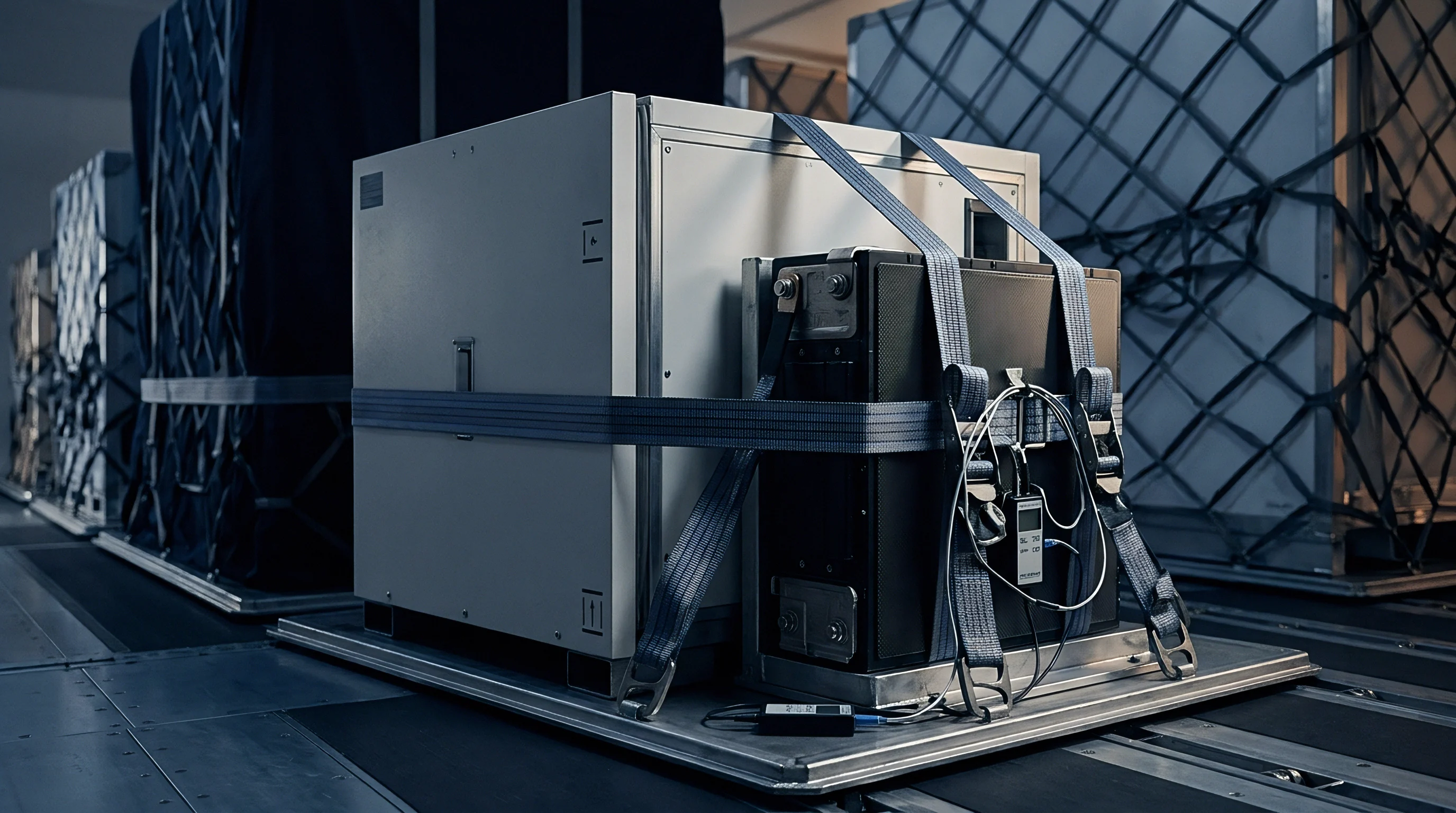
Sampling Strategies for High-Volume Battery Shipments
Sampling protocols prevent compliance teams from relying on superficial visual spot-checks. High-volume cell shipments call for structured acceptance sampling under ISO 2859-1 or ANSI/ASQ Z1.4 standards. Auditors set Acceptance Quality Limits (AQL) for documentation omissions and packaging defects alike.
Under an AQL of 0.65 for documentation, uncovering even two non-compliant test summaries in a sample lot forces the rejection of the entire booking.
Physical sampling requires dismantling selected outer pallets to inspect inner packaging directly. Auditors confirm that inner cartons contain adequate shock mitigation, that electrical terminals are insulated with non-conductive tape or caps, and that individual cell lot numbers match the manufacturing batch numbers on the UN 38.3 test summary. Finding serial number discrepancies signals a break in forwarder intake controls.
- Training Matrix Verification Reviewing staff CBTA certificates to confirm active training status across all operational shifts.
- Intake Checklist Auditing Cross-checking completed physical acceptance checklists against master transport declarations for historical accuracy.
- Digital Record Inspection Confirming two-year retention of UN 38.3 test summaries within the forwarder enterprise software platform.
- Physical Pallet Teardowns Sampling inner containers to verify individual cell terminal insulation and state of charge limits.
| Audit Category | Verification Method | Compliance Threshold | Action Plan |
|---|---|---|---|
| Documentation Integrity | 100% check of UN 38.3 summaries and DGDs | Zero missing fields, 100% lab accreditation match | Immediate booking freeze upon documentation gap detection |
| Staff Qualification | CBTA certificate audit across intake personnel | 100% valid training records within 24-month cycle | Re-assign uncertified staff away from dangerous goods counters |
| Physical Packaging | Visual and structural sampling per ANSI/ASQ Z1.4 | AQL 0.45 for box integrity, zero terminal exposure | Reject pallet lots exhibiting outer carton compression |
| State of Charge Control | Multimeter voltage sampling on UN 3480 lots | 100% of tested cells at or below 30% SoC voltage limit | Mandate factory discharge verification before hub intake |
| Audit scoring applies to all tier-one and tier-two freight forwarders handling air cargo battery shipments. | |||
Forwarders operating dedicated dangerous goods intake counters with calibrated testing equipment record significantly lower interdiction rates than operations relying on general freight handling channels.


Indemnity
Contractual risk allocation determines who bears the financial hit when non-compliant battery cargo is detained or causes catastrophic damage. Importers of record and sourcing teams must structure Master Services Agreements (MSAs) with freight forwarders to guard against liability stemming from non-compliant intake. Forwarders routinely limit their exposure using standard bill of lading conditions, capping liability at nominal rates per kilogram unless the shipper proves gross negligence.
Standard freight forwarding terms typically require the shipper to warrant full compliance with dangerous goods regulations and indemnify the forwarder against fines, losses, or legal costs caused by inaccurate paperwork. However, if a forwarder accepts visibly compromised packaging or skips fundamental UN 38.3 documentation checks, that indemnity protection frequently breaks down in legal disputes. Courts and arbitration panels assess whether the forwarder’s oversight at intake constitutes a breach of its duty of care as a specialized logistics agent.

Contractual Risk Allocation in Freight Forwarding
Maritime and aviation laws establish distinct liability regimes. Under the Montreal Convention for air cargo and COGSA for ocean transit, carrier liability caps do not shield entities that transport non-compliant dangerous goods. Transit insurance policies regularly exclude coverage for regulatory non-compliance or illegal acts, and insurers deny claims whenever an uncertified battery shipment accepted without valid UN 38.3 paperwork causes an onboard fire.
Importers need explicit risk-shifting provisions built into Master Services Agreements. These clauses obligate forwarders to complete mandatory acceptance checklists and assume direct indemnification liability for all costs if cargo is seized, delayed, or fined due to accepting documentation that violates regulatory standards.

Financial Impact of Cargo Interdiction and Regulatory Sanctions
Calculating the financial impact of non-compliant cargo acceptance means accounting for both direct penalties and broader supply chain disruption. When regulators like the FAA or PHMSA interdict non-compliant shipments at entry ports, fines and operational costs accumulate rapidly.
Consider an interdicted air cargo shipment of 10,000 unit cells declared under UN 3480. PHMSA civil penalties for offering or accepting non-compliant dangerous goods without valid UN 38.3 paperwork average 30,000 USD per violation. When customs officials uncover state of charge violations in tandem with missing test summary data, enforcement agencies treat them as separate, compounding infractions.
Beyond regulatory fines, port storage and bonded warehousing fees accumulate quickly. Bonded storage rates for interdicted hazardous freight average 1,500 USD per day due to strict isolation requirements. If a 40-foot container or air pallet remains in bonded hold for 45 days while audits and reviews play out, storage costs alone total 67,500 USD.
Repackaging and re-documenting the freight under certified supervision adds another 12,000 USD for labor and UN specification packaging materials. If safety concerns force the destruction of the shipment, certified disposal adds 4.50 USD per kilogram, turning a routine booking into a major balance-sheet loss.
Industry stakeholders continue to debate whether forwarders should face joint strict financial liability alongside shippers when uncertified battery chemistry triggers thermal runaway during intermodal transit.