Sourcing Models for Custom Lithium Ion Battery Packs
Structure custom pack sourcing by retaining mechanical IP and UN 38.3 file ownership while negotiating cell-direct contract manufacturing terms.


Boundary
Buying a battery pack without pinning down legal ownership of the interfaces between cells, housing, and protection electronics leaves unallocated technical risk on the buyer’s balance sheet. Custom energy storage procurement falls somewhere along a spectrum governed by who holds the CAD geometry, who maintains regulatory test reports, and who contracts for cell supply. Turnkey arrangements hand the entire bill of materials, tooling fixtures, BMS code, and compliance certifications to an outside vendor.
Build-to-print work flips that dynamic: the buyer’s internal team controls cell chemistry, board schematics, and mechanical housings, leaving the contract plant responsible purely for assembly execution and end-of-line pass rates.
This division determines who pays when cells drift out of balance or degrade early in field operation. In a turnkey engagement, non-recurring engineering, lab testing, and factory margin are rolled into a single fixed unit rate. That arrangement limits front-end development spend, but it masks bill-of-materials costs, cell lot test distributions, and internal battery management software.
When spot cell pricing drops, turnkey contracts keep buyers paying rates pegged to earlier baseline indices. This commercial friction surfaces whenever turnkey customers attempt to audit cell binning data, only to be blocked by proprietary vendor IP clauses.
Co-development models split the work between full turnkey supply and build-to-print execution. The customer typically specifies the physical envelope, heat rejection requirements, communication bus parameters, and approved cell manufacturers; the pack integrator routes the busbars, designs the cell carriers, and lays out internal wiring. Every interface demands its own controlled drawing.
If thermal responsibilities and allowable capacity fade thresholds remain vague, warranty disputes invariably follow when field units fail and neither party accepts fault for thermal hot spots versus factory workmanship.

Architectural Split between Off-The-Shelf and Custom Packs
Standardized catalog modules can be procured without tooling investment, but their fixed physical profiles and static pinouts force mechanical compromises into the host device. Fully custom packs maximize volumetric efficiency, integrate sealed ingress protection directly against mating components, shorten thermal conduction paths, and broadcast native CAN or SMBus frames aligned to system firmware. Designing from scratch allows the battery frame to serve as structural chassis webbing, cutting out duplicate wall thicknesses and eliminating dead volume.
Tooling commitments dictate early mechanical decisions. Fabricated sheet metal housings involve low initial NRE for laser profiling, press-brake bending, and weld jigs, keeping them viable for annual runs between 500 and 5,000 units. Injection-molded enclosures require hardened steel tooling that generally demands run volumes beyond 20,000 units to absorb capital costs.
Because an injection-molded shell often provides both structural isolation and electrical insulation, material choice is critical ~ frequently driving engineers toward flame-retardant polycarbonate-polybutylene terephthalate blends carrying a UL 94 V-0 rating.
Direct cell procurement fundamentally alters the supply contract. Sourcing straight from Tier-1 manufacturers secures raw batch capacity distributions, chemistry test records, and transparent volume tier breaks. The integrator then operates as a true contract manufacturer, receiving consigned cells, managing incoming inspection, and charging a discrete assembly fee per pack.
This removes third-party markup on cells, which account for 55% to 75% of total pack hardware costs.
System liability belongs entirely to whoever releases the mechanical drawing package to the tooling house.

Responsibility Boundaries in Off-Shore and Domestic Supply Chains
Cross-border sourcing brings transport regulations, extended transit times, and international IP enforcement risks that reshape project economics. Overseas pack assemblers provide low direct labor costs alongside dense local component ecosystems for nickel strip, silicone leads, molded spacers, and extruded heatsinks. Against those savings stand six to eight weeks of ocean freight, larger safety stock requirements, and exposure of compiled BMS firmware during on-line flashing at foreign facilities.
Domestic manufacturing shortens engineering turnaround, allows in-person sign-off on initial tooling samples, simplifies legal remedies, and eliminates international sea lanes. Because higher domestic wages penalize manual touch time, domestic viability leans on automated laser welding systems and robotic pick-and-place cell loading. Sourcing domestically also simplifies adherence to local manufacturing mandates, supply chain carbon accounting directives, and dual-use trade controls.
| Sourcing Model | Tooling NRE Ownership | Firmware & IP Control | Regulatory File Holder | Direct Cell Purchase Option |
|---|---|---|---|---|
| Turnkey OEM | Vendor Owned | Vendor Proprietary | Vendor | No |
| Semi-Custom Co-Dev | Shared / Amortized | Joint / Licensed | Buyer or Vendor | Conditional |
| Build-to-Print CM | Buyer Owned | Buyer Retained | Buyer | Yes |
Supply agreements must establish unambiguous receiving criteria. Incoming QA at the pack plant should replicate the cell supplier’s factory gate testing methods. If incoming cell lots diverge from factory grading sheets on open-circuit voltage or 1 kHz AC impedance, the line stops.
The contract must identify whether the cell supplier or the pack assembler bears carrying costs, floor space fees, and quarantine overhead while engineering arbitration sorts out the measurement delta.
In field disputes, pack assemblers frequently blame thermal degradation on cell lot impedance variation, while cell manufacturers counter that excessive mechanical stress during terminal welding damaged the internal jellyroll connection.

Format
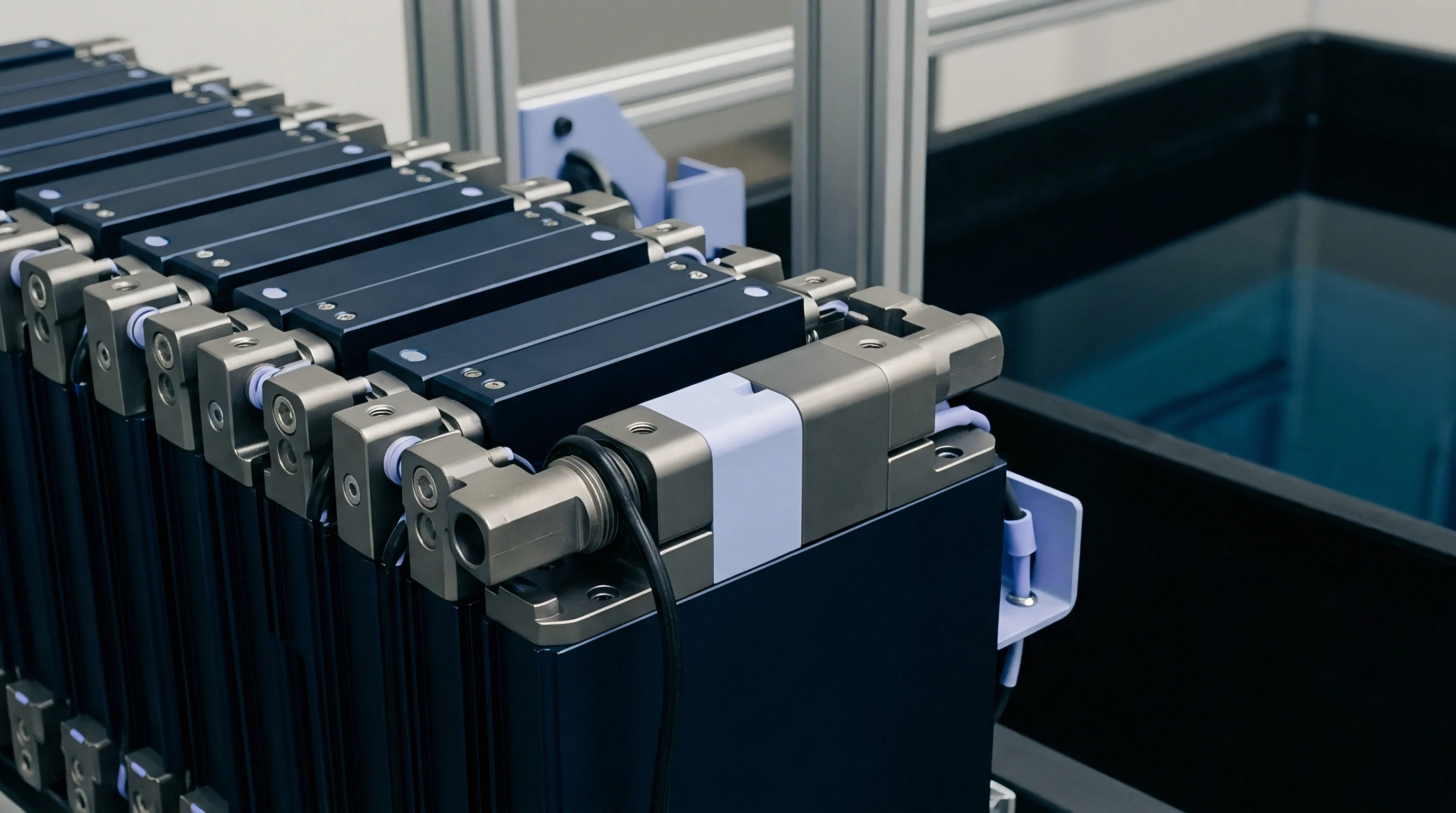
Selecting a cell geometry locks in the pack’s mechanical containment, electrical interconnect options, cooling loop geometry, and predominant failure modes. Cylindrical, prismatic, and pouch cells each manage internal pressure, mechanical impact, and cycling strain differently. Sourcing teams have to match the active chemistry to the mechanical package, because high-nickel chemistries behave quite differently inside deep-drawn steel cans than inside sealed polymer-aluminum barrier films.
Cylindrical formats ~ including 18650, 21700, and 4680 sizes ~ rely on drawn, nickel-plated steel cans that double as pressure vessels, holding internal gas pressure until a current interrupt mechanism disconnects. Their cylindrical geometry makes them easy to sort, orient, and interconnect via high-speed wire bonding or spot welding lines. Because the can supports internal hoop stresses, modules avoid heavy external compression hardware.
Interstitial spaces between nested cylinders penalize net volumetric density, but those identical gaps yield natural channels for cooling fluid ribbons or forced air.
Prismatic cells package wound or stacked electrode sets inside welded aluminum enclosures, maximizing volume utilization in cuboid spaces and scaling from 50 Ah to past 300 Ah per unit. Broad, flat aluminum walls offer large surface interfaces for bottom- or side-mounted chiller plates. However, cycling drives cyclic expansion across those broad faces as lithium migrates into the negative electrode, requiring structural endplates and tension rods engineered to hold continuous mechanical pressure between 0.3 MPa and 1.0 MPa.
Pouch cells deliver high gravimetric density by shedding rigid metal outer walls in favor of multilayer aluminum laminate pouches. Stripping that metal casing cuts mass and enables dense stacking within sub-assemblies. Yet pouch cells remain vulnerable to puncture, edge stress concentrations, and humidity ingress along the heat-sealed perimeter.
Working with pouch formats requires molded cell cassettes, elastomeric foam pads to absorb up to 10% cyclic swelling over operating life, and balanced face-cooling plates to eliminate internal thermal gradients.

Mechanical Containment Mechanics across Cell Formats
Electrode swelling drives enclosure stiffness requirements. Intercalating lithium into graphite forces lattice expansion, causing measurable mechanical growth during every charge cycle. Across thousands of cycles, ongoing solid electrolyte interphase formation and active material microcracking convert part of that expansion into permanent volumetric strain.
If pouch or prismatic designs fail to maintain calibrated stack pressure, electrodes delaminate, impedance climbs, local current density spikes, and micro-shorts develop prematurely.
Cylindrical cells resist radial swelling through the hoop strength of their steel casing. With the outer can maintaining dimensional stability across years of operation, mechanical tolerances for molded holders or potting tooling remain tight and predictable. Conduction out of cylindrical cells occurs primarily down the axial core and through the outer cylinder wall, requiring gap-filling interface compounds configured to transfer heat from curved surfaces onto flat cooling plates.
Factory scrap rates often trace directly to interconnect joinery. Cylindrical cells expose an axial positive terminal and a negative can base, calling for high-speed wire bonding or micro-resistance welding with pure nickel or nickel-clad copper tabs. Prismatic designs terminate in rigid aluminum and copper posts that accept bolted or laser-welded busbars, allowing field replacement and straightforward teardown for recycling.
Pouch cells extend bare copper and aluminum foil tabs that demand ultrasonic horn welding or controlled fiber-laser welds to avoid burning through delicate substrate foils.

Thermal Interface Engineering and Volumetric Packing Factors
Thermal management architectures mirror the internal heat generation paths and contact geometry of each form factor. In cylindrical designs, core heat must cross concentric wraps of active foil, polymer separator, and organic electrolyte before hitting the steel wall. In prismatic and pouch constructions, heat conducts rapidly out broad face areas straight into cold plates or phase-change gap fillers.
Volumetric packing efficiency reflects how much of the gross pack volume consists of active electrochemical material rather than structural casing, thermal hardware, and wiring runs. Cylindrical modules typically reach 50% to 65% packing efficiency once cell spacing rules, cooling ribbons, and structural carriers are factored in. Prismatic packs routinely operate between 70% and 82%, which explains their prevalence in stationary utility storage, heavy trucks, and industrial equipment where spatial constraints dominate.
- Separator Delamination occurs when flexible pouch cells cycle without uniform clamp pressure, causing localized impedance spikes and accelerated lithium plating.
- Tab Fatigue Fractures manifest under high-frequency vibration when rigid busbars lack strain-relief bends between adjacent prismatic terminals.
- Steel Can Puncture results from improper spot welding parameters on cylindrical cells, compromising lower cap thickness and causing slow electrolyte leaks.
- Seal Line Degradation develops along pouch cell perimeter seals exposed to high temperatures and corrosive electrolyte breakdown products over extended storage.
| Format Parameter | Cylindrical (21700) | Prismatic (94 Ah) | Pouch (60 Ah) |
|---|---|---|---|
| Housing Material | Nickel-Plated Steel | Aluminum Alloy | Aluminum Laminate Foil |
| Volumetric Efficiency | 55% – 65% | 70% – 82% | 75% – 85% |
| External Clamping Required | No | Yes (0.3 – 1.0 MPa) | Yes (0.2 – 0.5 MPa) |
| Interconnect Method | Wire Bond / Spot Weld | Bolted / Laser Weld | Ultrasonic / Laser Weld |
| Cyclic Thickness Swelling | < 0.5% Radial | 3% – 6% Axial | 8% – 12% Axial |
The cell format dictates line investment at the pack facility. Ultrasonic welding for pouch tabs calls for continuous acoustic horn maintenance and anvil gap calibration to prevent foil tears. Laser-welding prismatic busbars requires precise optical focus and joint gaps held below 0.1 mm, necessitating rigid pneumatic clamping fixtures on the line.
Spot welding cylindrical cells provides broader physical alignment windows, but pulse duration and electrode force need strict continuous monitoring to prevent punching through the safety vent or base cap.
While pouch cells present attractive gravimetric energy numbers on early datasheets, much of that margin disappears once structural clamping plates, cooling jackets, and rigid outer enclosure walls are added to the bill of materials.


Draft
Turning system requirements into a release drawing package requires tolerance stack analyses, high-voltage spacing reviews, thermal interface calculations, and environmental seal design. This drawing set forms the binding technical baseline between buyer and contract builder. If production drawings leave out thermal interface compression windows, torque tolerances, or busbar penetration depths, line disputes during volume bring-up are inevitable.
Structural design begins with dynamic load profiles. Mobile industrial equipment, utility machinery, and on-road vehicles expose packs to continuous multi-axis vibration and shock regimes like those outlined in UN 38.3 Test 3 and Test 4. Sheet metal housings made from 5052-H32 aluminum or cold-rolled steel require stamped stiffening beads and tuned isolator bushings to avoid structural resonance between 7 Hz and 200 Hz. Resonance within that frequency band strains busbar junctions, loosens threaded hardware, and shears structural adhesive joints.
High-voltage layouts depend on creepage and clearance boundaries. Creepage measures distance along the surface of an insulator between live potentials; clearance measures direct air distance. Packs operating above 60 V DC fall under high-voltage isolation standards including IEC 60664-1.
A 400 V DC system calls for at least 4.0 mm creepage under Pollution Degree 2, rising to 6.3 mm or higher if structural plastic resins drop below Material Group IIIa tracking indices. Internal barriers stamped from Nomex or Formex sheet provide reliable electrical isolation where mechanical packaging forces clearances below these base thresholds.
Tolerances compound rapidly across stacked assemblies. A pack module aligning twenty prismatic cells in series accumulates variation across cell thickness, isolation sheets, and compression pads. If each individual cell carries a thickness tolerance of ±0.3 mm, the total twenty-cell stack varies across a ±6.0 mm envelope.
Designing rigid endplates without Belleville springs, adjustable shims, or compliant microcellular foam inserts produces two distinct scrap conditions: insufficient stack compression across low-end cell lots, or severe over-compression and frame deflection on high-side lots.

Tolerance Accumulation in Hard-Shell Assemblies
Statistical 3D tolerance models should replace worst-case linear arithmetic. Worst-case stacking assumes every component hits its extreme physical limit in the same direction at the same time, producing bulky, overweight structures that squander internal space. Statistical Root-Sum-Square (RSS) calculations apply normal distributions to project actual assembly spreads, preserving spatial density while sustaining factory pass rates over 99.73%.
Module heat transfer relies on controlled interface pressure against thermal pads and chill plates. Phase-change materials and silicone interface pads generally require contact pressures between 0.15 MPa and 0.40 MPa to achieve their rated conductivities, which typically run from 1.5 W/m·K to 6.0 W/m·K. Under-compression traps microscopic air voids that throttle heat conduction; over-compression squeezes wet resin or silicone out of the joint, creating high local mechanical stresses on cell casings and reducing electrical tracking distances.
Meeting IP67 or IP69K ratings demands stiff mating flanges and controlled gasket squeeze. These seals use continuous molded silicone or EPDM profiles seated between flat mating surfaces. Fastener centers along sheet metal flanges should be kept within 60 mm to 80 mm; wider bolt spacings permit localized flange bowing under internal pressure, dropping gasket compression below the 25% minimum required to hold off high-pressure spray.
Robotically dispensed cure-in-place silicone gaskets eliminate manual seating mistakes on high-rate lines.

How Do Tooling Charges Shift under Ownership Changes?
Ownership terms for stamping dies, injection molds, and weld fixtures dictate future operational freedom. When a buyer covers tooling upfront under an explicit purchase order, legal title to the steel molds, stamping dies, and CAD drawings remains with that buyer. That documentation and ownership allows tooling to be transferred to a secondary plant if the primary supplier encounters quality issues or capacity bottlenecks.
Supplier-funded tooling amortizes capital costs into the unit price across an agreed volume commitment ~ frequently 50,000 units. While this preserves project capital during development, the contract manufacturer retains physical ownership and title to the molds. If the buyer tries to transition manufacturing before completing the volume schedule, the supplier will demand substantial tooling buyout fees or refuse to hand over CAD files, requiring complete re-tooling of the enclosure and busbar lines.
Busbars present a trade-off between stamped solid conductors and laminated flexible assemblies. Stamped copper busbars with tin or nickel plating offer low per-unit pricing at high volumes, though progressive stamping dies represent tens of thousands of dollars in front-end tooling. Laminated copper foil busbars flex under operational vibration and thermal expansion, isolating delicate cell posts from mechanical stress and justifying their higher material cost in high-reliability applications.

Busbar Joinery and Structural Creepage Distances
Fasteners on high-current busbar joints must maintain clamp pressure across thermal cycling and operational vibration. Copper busbars, aluminum terminals, and stainless steel fasteners expand at different rates as temperatures rise. Standard helical split washers relax over thermal cycling, resulting in high joint contact resistance, localized heating, and eventually thermal damage.
High-reliability assemblies use conical Belleville spring washers calibrated to maintain required clamp forces from -40°C to +85°C.
Dense cylindrical designs rely heavily on ultrasonic wire bonding or fiber laser welding. Micro-resistance welding using nickel strip remains viable for low-draw assemblies, but packs delivering continuous discharge rates above 100 Amperes per parallel bank need heavy aluminum or copper wire bonds. Fiber laser welding achieves sub-millisecond weld times with limited heat-affected zones, protecting terminal seals from degradation on automated production lines.
The following sequence outlines the tolerance stack-up calculation for a custom prismatic pack assembly:
- Establish the primary mechanical reference datum on the structural mounting face of the metal chassis box.
- Sum nominal component dimensions along the stack axis, including cell bodies, insulator plates, and compression pads.
- Calculate statistical component variation using Root-Sum-Square methods on supplier tolerance bands at three-sigma limits.
- Determine minimum and maximum thermal expansion deltas across operating temperatures using thermal expansion coefficients for aluminum, steel, and plastics.
- Calculate the physical compression window for internal silicone foam pads, confirming clamp pressure stays between 0.2 MPa and 0.5 MPa across all tolerance combinations.
Drawing packages should define maximum acceptable joint resistance following welding. Laser-welded copper-to-aluminum joints must measure below 0.15 mΩ DC using a four-wire Kelvin micro-ohmmeter across the interface. Higher resistance points to intermetallic phase growth, insufficient weld depth, or porosity, requiring automated rejection at the assembly cell.
Section 14.2 of the master manufacturing agreement specifies that all physical injection molds and stamping dies purchased under client NRE purchase orders remain the exclusive property of the client, transferable upon thirty days written notice without exit fees.


Pilot
Transitioning an energy storage project from initial prototypes into volume manufacturing follows a structured New Product Introduction (NPI) framework. The NPI pipeline bridges low-volume engineering builds and automated lines, exposing tooling misalignments, line bottlenecks, and yield drops early. Skipping these intermediate pilot phases to chase delivery dates consistently leads to high scrap levels, low throughput, and expensive warranty field actions.
Prototype assembly ~ the Engineering Validation Test (EVT) stage ~ relies on 3D-printed cell spacers, soft tooling, manual busbar welding, and prototype BMS boards. EVT validates mechanical packaging in the end product, measures initial electrical performance, and screens early packs against UN 38.3 transport profiles. Engineering teams build 5 to 20 units by hand in a laboratory setting.
Data from these builds highlights internal packaging interferences, routing errors, and tight harness runs inside the chassis.
Design Validation Test (DVT) runs introduce production-intent molded structural plastics, stamped busbars, and production-grade BMS circuit boards. Technicians build 50 to 200 DVT packs using pilot assembly fixtures. This stage proves design compliance across environmental and mechanical operating limits ~ subjecting packs to thermal shock, ingress verification, mechanical vibration, and continuous cycling at temperature extremes.
Production Validation Test (PVT) units represent the final checkpoint before mass production sign-off. PVT packs run on the dedicated commercial production line using production tooling, line robotics, shop floor technicians, and automated End-of-Line (EOL) test stations. A successful PVT run proves that the line can hit target cycle times, maintain process capability indices, and achieve yield targets.
Finished PVT units serve as commercial pilot inventory and provide samples for regulatory testing.

First-Article Cadence and Line Takt Discrepancies
First-article inspection requires complete dimensional, metallographic, and functional verification of initial components off hard production tooling. Critical features identified on the engineering drawings are measured using optical comparators, coordinate measuring machines, and calibrated gauges. This process confirms that multi-cavity molds, progressive stamping dies, and automated weld tooling produce parts within tolerance before running volume production.
Line takt time governs the assembly cadence needed to hit contractual delivery rates. Pilot builds often expose discrepancies between calculated cycle times and actual line performance. Wiring harness routing, liquid thermal compound dispensing, and elastomeric gasket installation routinely become line bottlenecks, forcing process engineers to add automated dispensing systems or redesign snap-fit clips to meet takt targets.
Yield tracking plots line capability alongside operator skill acquisition. Early EVT runs often settle at 70% to 80% pass rates because of manual handling slips, damaged insulation sleeves, or unoptimized welding parameters. DVT targets line yields of 92% or better, while PVT requires sustained automated line yields exceeding 98.5%.
Scrap generated during pilot validation is tracked through formal 8D problem-solving processes to close out failure modes before mass ramp.

Weld Integrity and Electrical Screening Protocols
Automated weld monitoring is critical for inline battery pack quality. Modern laser and resistance welders incorporate sensors that record weld pool optical backscatter, infrared emission curves, current delivery, and vertical head displacement in real time. A process trace reading outside pre-set process control bands flags that sub-module for immediate rejection before it moves to the next assembly station.
| NPI Phase | Build Quantity | Tooling Status | Primary Objective | Minimum Target Yield |
|---|---|---|---|---|
| EVT | 5 – 20 Units | Soft / 3D Printed | Mechanical Fit & Electrical Verification | 75.0% |
| DVT | 50 – 200 Units | Production Intent | Design Compliance & Safety Certification | 92.0% |
| PVT | 100 – 500 Units | Hard Production Line | Line Speed & Process Capability Validation | 98.5% |
Self-discharge screening measures open-circuit voltage decline over time to catch internal micro-shorts prior to pack integration. Following initial capacity binning, cells sit in temperature-controlled rooms for 7 to 14 days. Measuring voltage drop across that hold duration yields the cell K-value in mV/day.
Any cell showing an elevated K-value indicates separator damage or microscopic metal particulate contamination and is discarded.
End-of-Line testing subjects fully assembled battery packs to automated electrical diagnostics before final boxing. The automated EOL station verifies BMS firmware checksums, tests CANbus, Modbus, or SMBus communication links, checks pack isolation resistance, cycles high-voltage contactors, and verifies onboard thermistor calibration. Test records upload straight to the plant’s manufacturing execution system, linking each pack’s serial number to its sub-component traceability lot codes.
A misalignment in automated laser weld vision systems on reflective busbar plating can destroy forty-eight sub-modules before line sensors register the offset, driving a thirty-two thousand dollar scrap loss.


Paperwork
Meeting compliance requirements for lithium-ion storage systems demands rigorous documentation control, specialized laboratory testing, and clean legal ownership of regulatory dossiers. An engineered pack cannot ship commercially if it lacks transport compliance or safety certifications. Sourcing contracts must clearly state who submits regulatory applications, who finances laboratory testing when engineering changes occur, and who carries liability if an agency audit exposes flaws in testing documentation.
UN 38.3 transport certification is mandatory for transporting lithium-ion cells and completed battery assemblies via road, ocean, or air. Administered under the UN Manual of Tests and Criteria, it details eight stress tests (T1 through T8): altitude simulation (T1), thermal cycling between -40°C and +72°C (T2), frequency-swept vibration (T3), mechanical shock up to 150g (T4), external short circuit at elevated temperature (T5), impact or crush testing (T6), forced overcharge (T7), and forced deep discharge (T8). Completing UN 38.3 testing permits generation of the Dangerous Goods Safety Data Sheet and the formal Transport Summary Report required by commercial freight handlers.
Product-level safety standards address operational risks in the field. UL 1642 regulates single cells, focusing on casing pressure vents and resistance to internal shorts under physical and thermal abuse. UL 2054 covers complete portable battery packs, demanding dual-fault tolerance, overcurrent protection, thermal cutoffs, and physical drop durability.
In Europe, packs for portable commercial and consumer gear must comply with IEC 62133-2, along with relevant CE directives covering electromagnetic compatibility (IEC 61000 series) and low-voltage electrical safety.
The EU Battery Regulation introduces lifecycle tracking rules for packs entering European territory. This regulation mandates supply chain due diligence reports, hazardous substance restrictions, minimum recycled content thresholds for lithium, nickel, and cobalt, and a digital Battery Passport for systems exceeding 2 kWh. This digital record must capture cell chemistry, embedded carbon footprint, factory location, cycle life models, and dismantling steps ~ all queryable through a QR code stamped on the pack exterior.
Regulatory Dossier Ownership and Certification Transfer
Legal ownership of regulatory test files controls commercial flexibility. If a buyer relies on a turnkey vendor’s compliance filings, that vendor holds the laboratory reports and agency listings in their own name. If the buyer subsequently shifts production to an alternate supplier, those listings do not move.
The buyer must repeat lab testing and re-certify the product, adding months of delay and tens of thousands of dollars in outside test fees.
Drafting contracts to establish the buyer as the legal applicant on certification files preserves operational agility. In this setup, the test agency registers the buyer as the primary certificate holder and names the factory as an approved assembly site. If production moves to a new facility, the certificate holder submits a site inspection update rather than rerunning the complete mechanical and electrical abuse suite.
Engineering changes to an active pack often invalidate existing certifications. Replacing a power MOSFET, substituting plastic casing resin, or qualifying an alternate cell supplier voids active UN 38.3 and UL files. Sourcing teams need to account for both laboratory costs and testing lead times for delta-evaluations or complete re-testing whenever engineering change notices are processed.

Transport Hazard Classification and Testing Evidence
Transportation frameworks designate lithium batteries as Class 9 dangerous goods under dedicated UN numbers. Standalone packs ship under UN 3480; packs packed alongside or installed within host devices fall under UN 3481. Transporting damaged, defective, or recalled packs requires specialized fire-suppression packaging and specific regulatory dispensations, with steep penalties for violations.
Air cargo regulations enforce strict state-of-charge ceilings. ICAO and IATA rules prohibit shipping standalone lithium-ion batteries in passenger aircraft bellies and limit cargo aircraft shipments to a maximum 30% state of charge at pickup. Pack assembly plants must include automated EOL discharging equipment to pull pack charge down into this 30% window prior to final shipping box closure.
A complete regulatory dossier for a custom lithium-ion pack includes these core engineering documents:
- UN 38.3 Test Summary Report validating completion of altitude, thermal, vibration, shock, short-circuit, impact, overcharge, and forced discharge test sequences.
- Safety Data Sheet compiled in accordance with Globally Harmonized System standards detailing chemical constituent hazards, fire-fighting measures, and transport classifications.
- Declaration of Conformity certifying compliance with applicable European directives, including CE marking, RoHS hazardous substance limits, and REACH chemical standards.
- UL Listing Certificate or IEC test report file confirming compliance with UL 2054, UL 1973, or IEC 62133-2 safety standards.
- Battery Passport Dataset containing carbon footprint calculations, material origin tracking, and repair disassembly protocols mandated by regional regulatory frameworks.
A break in physical traceability between cell lot numbers, BMS hardware revisions, and lab test reports frequently stops shipments at customs clearance points.
How strictly regulators will enforce digital Battery Passport due diligence rules on small and medium enterprise importers remains an open question for cross-border logistics teams.


Amortization
Calculating landed costs requires aggregating development NRE, physical tooling, raw BOM costs, scrap allowances, import tariffs, freight premiums, and the cost of holding inventory. Reviewing vendor quotes solely on finished unit cost hides front-end capital exposure, leading to budget deficits during pilot bring-up. A comprehensive financial model tracks cost-down curves across multi-year volume commitments under realistic manufacturing yields.
NRE outlays cover BMS firmware architecture, PCB design, 3D CAD modeling, mechanical FEA, thermal CFD runs, and line assembly jig design. Domestic engineering charges generally run from $50,000 for compact low-voltage batteries up to $500,000 or more for complex high-voltage, liquid-chilled systems. Sourcing teams typically structure payment milestones tied to engineering gates: 20% on contract signing, 30% on EVT prototype delivery, 30% upon DVT sign-off, and 20% following final PVT run validation.
Tooling capital covers the hard assets required to manufacture custom parts. Multi-cavity injection molds for plastic cell holders and outer casings represent significant financial outlays. High-cavitation steel tooling delivers low part costs at production volumes, but demands large upfront capital.
Soft prototype tooling or machined aluminum molds reduce front-end spend for EVT and DVT pilot batches, but wear quickly and drift outside the dimensional tolerances demanded on volume PVT assembly lines.

Non-Recurring Engineering Amortization and Unit Cost Curves
Amortizing NRE and tooling charges across cumulative production volume identifies the breakeven threshold against standard catalog modules. Absorbing $150,000 in front-end development across 1,000 packs adds $150.00 to each unit. Distributed across 50,000 packs, that overhead drops to $3.00 per unit, shifting the net economic equation strongly in favor of proprietary engineering.
Direct materials costs depend largely on cell purchasing leverage. Cell costs fluctuate alongside raw commodity market indices for lithium carbonate, nickel sulfate, cobalt sulfate, and synthetic graphite. Tier-1 manufacturers establish volume pricing tiers based on annual megawatt-hour volume commitments.
A buyer purchasing 5 MWh annually pays a noticeable per-kWh premium compared to an enterprise contracting for 500 MWh, which makes established third-party pack aggregators competitive for smaller programs.
Factory yield directly influences unit manufacturing costs. An assembly line running at 97% first-pass yield carries a 3% scrap burden in its cost structure. In dense packs containing hundreds of 21700 cells, a single damaged weld or shorted PCB trace during final testing can scrap the complete module if polyurethane potting or laser-welded busbars prevent non-destructive rework.
Where rework is impossible, scrap costs compound quickly, reinforcing the need for strict screening of incoming components.

Landed Cost Structure across Global Freight and Duty Schedules
Logistics and import duties represent volatile cost drivers in international supply models. Finished lithium battery shipments clear customs under specific Harmonized System designations, such as HS Code 8507.60.00. Tariffs vary based on bilateral trade agreements, component origin declarations, and local trade policies.
For example, US Section 301 tariffs on Chinese-assembled battery packs add up to 25% in duties, changing the economic balance between domestic manufacturing and foreign turnkey options.
| Cost Component | Off-Shore Turnkey ($/Unit) | Domestic CM ($/Unit) | Cost Variance Driver |
|---|---|---|---|
| Direct Cell Cost (Lithium Iron Phosphate) | $145.00 | $135.00 | Direct cell volume agreement savings |
| Enclosure, BMS, & Mechanical BOM | $85.00 | $92.00 | Domestic vs off-shore component sourcing |
| Assembly Labor & Line Operations | $22.00 | $48.00 | Line automation vs manual labor rates |
| Amortized NRE & Hard Tooling ($180k total) | $18.00 | $18.00 | Equal amortization over 10,000 units |
| Regulatory Testing & Certification | $4.50 | $4.50 | Fixed laboratory testing cost allocation |
| Hazardous Cargo Ocean Freight & Insurance | $16.50 | $3.20 | Class 9 hazardous container ocean shipping |
| Customs Duties & Section 301 Tariffs | $43.75 | $0.00 | 25% Section 301 tariff on off-shore pack |
| Total Landed Unit Cost | $334.75 | $300.70 | Tariff & freight offset domestic labor premium |
Dangerous goods shipping surcharges add meaningful line-item cost. Class 9 shipments demand UN-rated corrugated or timber containers fitted with flame-retardant liners and non-conductive padding, adding $15 to $30 per box on industrial-sized packs. Ocean shipping lines apply dangerous cargo handling fees, while air carriers enforce strict package size and weight ceilings.
Transit insurance policies also carry higher premiums to account for thermal event risks during transit.
Inventory carrying costs represent a substantial secondary cost in extended ocean pipelines. Sourcing from overseas plants requires issuing purchase orders and securing letters of credit 16 to 24 weeks prior to container arrival. Financing working capital tied up in long ocean voyages and port safety stock strains balance sheet liquidity.
Factoring these carrying costs into financial comparisons clarifies the true trade-off between overseas turnkey programs and shorter, more adaptable domestic supply chains.
The landed cost equation between offshore turnkey sourcing and domestic contract manufacturing flips when high tariffs and hazardous freight surcharges outweigh overseas labor savings. Factoring in NRE amortization, cell purchasing power, tariffs, scrap rates, and inventory carrying costs gives sourcing teams the quantitative foundation needed to negotiate sound contracts and build resilient supply chains.