Inbound Receiving Inspection and Hazardous Cargo Documentation Audit Procedures
Inbound cell inspection requires dual-path verification of UN 38.3 documentation and AQL sampling of open-circuit voltage, impedance, and K-value drop.


Crate
Inbound pallets must be physically verified before crew move them onto warehouse staging racks. When handling class nine dangerous goods, there is no allowance for structural packaging damage, breached containment, or unreadable labels. A single crushed carton corner or an uncalibrated shock sensor log is enough to hold receipt, quarantine the shipment, and freeze vendor payment.

Dockside Physical Integrity and Thermal History
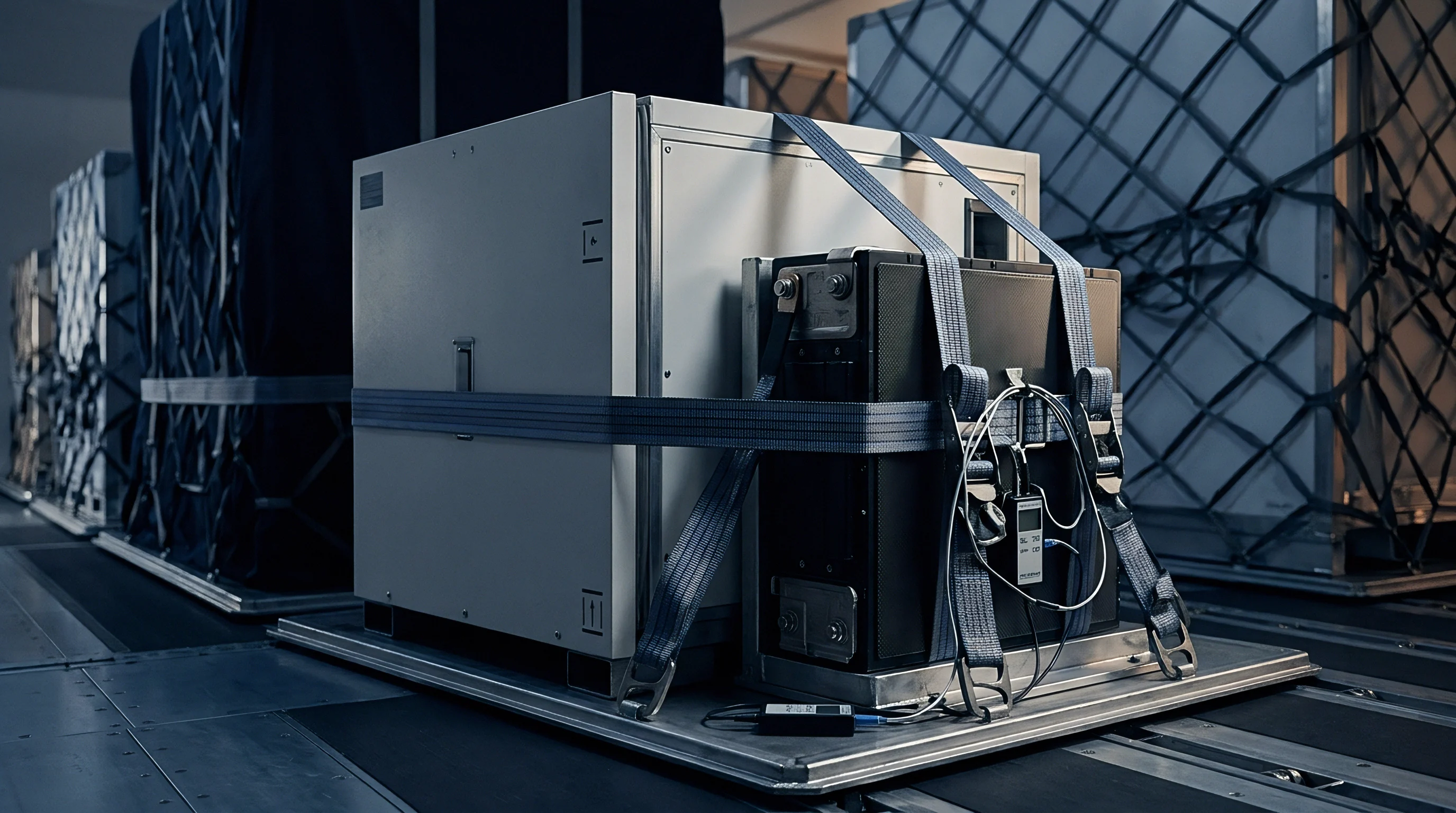
Outer container inspection starts with checking for crushing, moisture damage, or torn tamper tape. Inspectors check shock watch indicator seals before cutting security bands. Impact sensors rated at 25g or 50g mounted to the outer frame provide mechanical proof of mishandling during port transshipment or intermodal transit.
Moisture alone cuts corrugated fiberboard burst strength by over forty percent, which can cause high-bay warehouse stacks to collapse.
Inspect every security seal first.
Thermal loggers inside the crates record environmental conditions along sea and air routes. Lithium iron phosphate and nickel manganese cobalt cells exposed to ambient heat over sixty degrees Celsius in tropical port holds suffer rapid solid electrolyte interphase breakdown. That degradation cuts capacity before the lot even reaches incoming inspection.
Data from digital recorders should be downloaded right away over direct USB or short-range wireless links to confirm temperatures stayed between fifteen and thirty-five degrees Celsius throughout transit.
Document audit failures identified on the receiving dock take ten times longer to resolve once freight has entered bonded warehouse storage.
International shipments using solid wood packaging must comply with ISPM 15 heat-treatment standards. Customs officers will detain pallets lacking the recognized wheat-stamp logo, forcing re-palletization at receiver expense. Structural corner boards, plastic stretch wrap, and heavy steel or polyester strapping keep multi-layer stacks rigid.
If individual boxes shift inside a palletized unit, factory tensioning was inadequate, leaving internal cell terminals vulnerable to friction and short circuits.
Crushed packaging invalidates transport safety.
Moisture ingress promotes corrosion.
- Structural Box Creasing Outer fiberboard wall deformation deeper than ten millimeters invalidates UN packaging rating compliance and requires immediate box quarantine.
- Triggered Impact Indicators Activated red dye inside shock watch windows proves dynamic loads exceeded allowable transport thresholds during forklift transfer or ocean passage.
- Ruptured Security Strapping Broken poly-strapping or torn shrink wrap allows internal box movement, increasing terminal impact risks during transit.
- Saturated Wooden Skids Excess moisture on wooden pallet bases promotes mold growth and reduces timber compression capacity under multi-tiered warehouse stacking.
- Thermal Logger Violations Temperature excursions above fifty-five degrees Celsius recorded on internal data loggers trigger mandatory lot-wide electrochemical degradation audits.

UN Specification Outer Packaging and Labeling Mandates
Hazardous cargo regulations enforce strict structural performance criteria for foreign containers carrying class nine lithium iron phosphate or nickel manganese cobalt cells. Certification marks stamped directly onto outer fiberboard walls confirm completion of drop testing, stacking weight verification, and internal pressure retention. A standard UN 4G or UN 4GV designation proves the container design passed drop tests from a height of 1.2 meters onto solid concrete while fully loaded.
Missing or smudged specification codes strip the shipment of transport compliance, making cargo onward routing illegal under domestic freight laws.
Defective labels delay customs release.
Hazardous material labels applied to outer crate faces alert logistics handlers and emergency responders to specific risk profiles. Every standalone cell crate under United Nations number 3480 demands the primary Class 9 Dangerous Goods hazard diamond alongside the dedicated Lithium Battery Mark. Air transport consignments under Packing Instruction 965 call for the Cargo Aircraft Only warning sticker, restricting shipment boarding to dedicated freighter aircraft.
Label dimensions, color contrast ratios, and border hatchings follow strict regulatory measurements, where unauthorized alterations lead to customs rejection.
Internal cushioning structures prevent terminal contact and mitigate thermal runaway risks between adjacent cells. Non-combustible, non-conductive padding like expanded polypropylene, vermiculite, or custom molded ceramic wool inserts isolate individual cell terminals. The packaging layout prevents free movement of components inside the box, absorbing vibration generated during long-distance truck haulage or ocean freight pitching.


Manifest
Audits of hazardous cargo documentation begin the moment the carrier hands over the bill of lading and packing list. Discrepancies between printed paperwork details and physical container contents instantly trigger regulatory holds at port customs gates. A complete, clean document package is the primary defense against shipping delays, regulatory fines, and denied insurance claims following transit incidents.

Dangerous Goods Declaration and Packing Instruction Compliance
Shippers of class nine consignment stock must confirm that every dangerous goods document includes exact net mass figures and proper shipping names. The Shipper’s Declaration for Dangerous Goods serves as the central legal instrument binding the manufacturer to international freight safety covenants. Proper Shipping Names must match United Nations designation UN 3480 for standalone lithium ion cells or UN 3481 for cells packed with or contained in equipment.
Net battery weight figures printed on the declaration must match dock scale measurements within zero-point-five percent.
Paperwork errors halt freight clearance.
Air transport compliance under International Air Transport Association rules depends on adherence to Packing Instruction 965. Section IA applies to large shipments where cell capacities exceed twenty watt-hours, requiring full Class 9 documentation, emergency response contacts, and formal shipper signatures. Section IB applies to smaller quantities but demands equal rigor regarding package gross mass caps and dangerous goods handling statements.
State of Charge limitations strictly enforce a maximum thirty percent state of charge for standalone cells loaded onto commercial freighter aircraft, requiring factory state of charge validation reports inside the shipping dossier.
Ocean freight under the International Maritime Dangerous Goods Code relies on Special Provisions 188, 230, and 384 to govern container stowage and segregation. Auditors cross-reference every air waybill against section 3.9 of the dangerous goods declaration. Special Provision 188 offers partial relief for small cells, but commercial import volumes of industrial cells land under full dangerous goods regulation.
Marine transport documents specify container packing certificates, confirming ocean containers were dry, structurally sound, and correctly stowed away from heat sources prior to ship loading.
- Verify that the Proper Shipping Name matches UN 3480 exactly across every page of the dangerous goods declaration.
- Cross-check gross and net mass figures against ocean bill of lading and dock scale intake measurements.
- Confirm the presence of a 24-hour emergency phone response contact provided with international dial codes.
- Validate that the Shipper’s Declaration features a valid red hatch border and authorized agent signature.
- Review state of charge factory certificates to ensure compliance with thirty percent air transport limits.

Verification of UN 38.3 Lithium Battery Test Summaries
International regulations enforce the inclusion of a standardized regulatory document detailing eight specific safety trials. United Nations standard 38.3 mandates rigorous mechanical, thermal, and electrical tests on cell designs prior to commercial transport approval. The UN 38.3 Test Summary document replaces lengthy confidential engineering reports with a standardized single-page certificate containing ten mandatory data points.
Customs agents cross-reference test summary serial numbers against online testing laboratory databases to detect counterfeit compliance filings.
Log temperature profiles upon intake.
| Document Type | Governing Standard | Critical Audit Attributes | Non-Compliance Consequence |
|---|---|---|---|
| Shipper’s Declaration | IATA DGR / IMDG Code | UN Number, Proper Shipping Name, Net Mass, Red Hatching | Cargo seizure, airport refusal, immediate carrier fines |
| UN 38.3 Test Summary | UN Manual Tests Criteria 38.3 | Lab ISO 17025 accreditation, signature, cell mass, model match | Customs clearance rejection, invalidation of insurance |
| Safety Data Sheet (SDS) | OSHA HazCom / GHS Rev 9 | 16-section format, emergency phone, chemical composition, flash point | Warehouse entry denial, ocean carrier booking cancellation |
| State of Charge Certificate | IATA PI 965 Section IA/IB | Factory SOC logs, batch lot serials, calibrated tester stamps | Air freight rejection at carrier acceptance desk |
Test summaries list completed trials including altitude simulation, thermal cycling, vibration, shock, external short circuit, impact/crush, overcharge, and forced discharge. Test report dates must precede cell shipment dates, and cell model designations on intake boxes match test summary identifiers down to the final dash suffix. Third-party testing laboratories issuing these certificates maintain ISO/IEC 17025 accreditation, which receiving auditors verify through international laboratory accreditation cooperation portals.

Cross-Checking Operator Variations and Air Waybill Data
Airlines routinely implement internal transport conditions that exceed standard dangerous goods regulations. Major global carriers publish specific operator variations in annual dangerous goods manuals, restricting cell transport beyond standard international rules. Certain carriers prohibit all Section IB air shipments or limit maximum net battery weights per package to well below international standards.
Receiving audit teams verify that cargo routing aligns with airline-specific variations before flight departure to avoid cargo stranding at international transfer hubs.
A missing UN 38.3 test summary signature halts international customs clearance faster than physical container damage.
Air waybills and ocean bills of lading carry specific handling declarations in the nature and quantity of goods field. Statements like “Lithium ion batteries in compliance with IATA PI 965 Section IA” must appear verbatim to allow airline cargo handlers to accept pallets. Mismatches between air waybill descriptions and dangerous goods declaration entries cause immediate carrier rejection, incurring expensive port storage and re-documentation fees.
Commercial contracts specify that compliance with section 8.1.6.9 of the dangerous goods regulations forms an absolute precondition for final invoice settlement and customs transfer.


Sampling
Receiving teams apply statistical intake frameworks to determine how many boxes from an incoming shipment undergo physical teardown and electrical screening. Inspecting every single cell in a million-unit import lot generates massive labor costs and delays factory throughput. Acceptance sampling balances statistical confidence against inspection cost, identifying batch quality defects before raw materials flow into pack fabrication lines.

Acceptance Sampling Frameworks for Battery Import Batches
Statistical intake schemes defined by international quality standards establish clear sample counts based on overall lot volume. The ANSI/ASQ Z1.4 and ISO 2859-1 standards govern attribute sampling plans through defined inspection levels. General Inspection Level II represents the standard baseline for inbound quality audits, mapping lot sizes to specific code letters that dictate sample size.
Special Inspection Levels S-3 and S-4 allow smaller sample sizes for destructive or time-intensive testing, such as physical teardown and thermal abuse evaluations.
Discard cells exhibiting zero voltage.
Sample selection follows strict random sampling protocols to ensure representative lot evaluations. Quality technicians draw samples across multiple pallets, layers, and crates rather than pulling exclusively from top-level boxes. Pulling samples uniformly across early, middle, and late production batch runs catches factory drift issues that occur during long manufacturing cycles.
Automated random number generators map pallet coordinates to specific box serial numbers before warehouse inspectors cut pallet bands.
Section 5.2 of the UN Manual of Tests and Criteria invalidates transport authorization if cell mass deviates by more than 0.1 percent from tested design specifications.

Defect Classification and Lot Acceptance Thresholds
Quality management protocols categorize cell anomalies into distinct severity bands to govern rejection authority. Acceptable Quality Limit thresholds define the maximum allowable percentage of defective units within an intake lot. Reaching or exceeding specified defect limits forces immediate batch rejection, holding the entire container in quarantine for vendor disposition.
Track voltage decay over time.
- Critical Defects (AQL 0.00%) Electrolyte leakage, reverse polarity, crushed headers, or missing safety vents trigger immediate lot rejection and vendor notification.
- Major Defects (AQL 0.25%) Open-circuit voltage deviations beyond specification, elevated internal resistance, or illegible barcode matrices force lot quarantine.
- Minor Defects (AQL 1.00%) Surface scratches on shrink sleeves, tray discoloration, or minor packaging denting allow lot acceptance under controlled deviation notices.
- Dimensional Non-Conformances (AQL 0.40%) Diameter or thickness swelling exceeding engineering tolerances requires physical lot hold to prevent pack assembly binding.
Switching between normal, tightened, and reduced inspection levels depends on historical vendor performance trends. Receiving a failed lot under normal inspection forces an immediate transition to tightened inspection, increasing sample size requirements for subsequent shipments. Returning to normal inspection requires five consecutive clean batches under tightened controls, protecting receiving operations against recurring vendor manufacturing defects.
A double sampling plan gives a questionable batch a second statistical chance, but doubling the sample count after first-lot defect detection doubles incoming audit labor costs.


Metrics
Incoming cell lots face rigorous electrical and physical verification trials to filter out factory escapes before warehouse rack placement. Automated screening fixtures evaluate core electrochemical parameters within seconds per cell, building statistical distributions for every incoming shipment. Deviations from narrow bell-curve distributions highlight lot contamination, inconsistent slurry mixing, or improper electrolyte aging at the supplier facility.

Open Circuit Voltage and Impedance Screening Benchmarks
Digital multimeters and high-precision AC milliohm meters record foundational baseline electrical values for every selected cell. Open-circuit voltage screening isolates severely discharged units, manufacturing defects, or internal short circuits. High-grade lithium iron phosphate cells exhibit remarkably flat discharge curves, requiring voltage measurement meters calibrated to six-digit microvolt resolution to detect subtle state-of-charge variance.
Receiving facilities maintain ambient temperature within 0.5 degrees Celsius during impedance logging.
Record baseline electrical values immediately.
Impedance measurements utilizing 1-kilohertz alternating current milliohm meters evaluate internal cell conductivity and terminal weld integrity. AC internal resistance readings mirror high-frequency ion movement across the electrolyte-separator boundary, capturing collector tab attachment quality. DC internal resistance tests apply heavy current pulses to measure real-world voltage drops under load.
Comparing 1-kilohertz AC resistance against DC resistance pinpoints contact resistance anomalies, separator micro-pores, or incomplete electrolyte wetting.
Impedance spikes signal internal breakdown.
Temperature compensation formulas adjust raw voltage and impedance values back to a twenty-five degree Celsius baseline. Cell internal resistance drops significantly as temperature rises, masking degradation when testing warm cells fresh off ocean transport containers. NTC temperature sensors mounted directly against cell walls provide real-time thermal feedback, allowing software algorithms to correct raw milliohm readings before comparing values against pass-fail thresholds.

Quantifying K-Value Self-Discharge Rates in Storage
Voltage drop measured over time serves as the primary diagnostic metric for identifying internal micro-short circuits. The self-discharge rate, or K-value, quantifies the daily voltage decay rate of a cell stored in steady thermal environments. K-value calculations follow the simple differential formula:
K = (OCV1 – OCV2) / Δt
where voltage is recorded in millivolts and time interval Δt is measured in days. Normal lithium-ion self-discharge rates range between 0.1 and 0.4 millivolts per day under standard warehouse storage temperatures.
Elevated K-values expose latent internal short circuits caused by metallic particle contamination during cell winding or stacking. Microscopic iron or copper debris introduced during electrode slitting slowly migrates through separator pores, establishing micro-conductive bridges between cathode and anode layers. Cells exhibiting elevated K-values risk spontaneous thermal runaway during initial formation cycles or field operation.
Quality inspectors reject lots showing a mean voltage drop of 1.2 millivolts per day over 14 days.
Quarantine holds lasting fourteen to twenty-eight days allow accurate K-value calculation across inbound lots. Initial voltage readings taken during dock intake form the baseline OCV1, followed by a second reading OCV2 taken prior to warehouse release. Software automated screening bins group cells by K-value profiles, isolating outlier units that fall outside four-sigma distribution bounds even if absolute voltage remains within nominal datasheet ranges.

What Physical Dimensions Indicate Structural Deformation?
Digital vernier calliper readings across cell thickness, width, and height reveal internal gas generation or pouch swelling. Prismatic and pouch cells expand perpendicular to electrode planes as solid electrolyte interphase layers grow or trace moisture reacts with lithium hexafluorophosphate salt. Measuring pouch thickness under controlled compression loads, typically 300 kilopascals, standardizes dimensional audits against vendor datasheet specifications.
| Cell Chemistry and Format | Screening Parameter | Nominal Value | Acceptable Batch Tolerance | Lot Rejection Threshold |
|---|---|---|---|---|
| 21700 NMC (4.8 Ah) | Open Circuit Voltage | 3.650 V | ±0.015 V | >0.030 V delta across lot |
| 21700 NMC (4.8 Ah) | 1 kHz AC Resistance | 12.5 mΩ | ±0.8 mΩ | >1.5 mΩ deviation from mean |
| 300 Ah LFP Prismatic | Open Circuit Voltage | 3.285 V | ±0.005 V | >0.012 V delta across lot |
| 300 Ah LFP Prismatic | 1 kHz AC Resistance | 0.18 mΩ | ±0.02 mΩ | >0.04 mΩ deviation from mean |
| 300 Ah LFP Prismatic | 14-Day K-Value Drop | 0.15 mV/day | <0.35 mV/day | >0.50 mV/day in any single unit |
Cylindrical cell checks focus on height, can diameter, and top-cap concentricity to guarantee seamless automated module assembly. Can swelling near cell headers indicates internal pressure buildup caused by electrolyte gas generation during high-temperature shipping holds. Dimensional checks include measuring cell sleeve insulation thickness and dielectric breakdown resistance, preventing frame shorting when cells press into aluminum module chasses.
Cells stored at 25 degrees Celsius exhibiting a K-value exceeding 0.8 millivolts per day over a 14-day hold period signal micro-short formation.
Unnoticed AC resistance drift on a twenty-megawatt-hour container shipment resulted in a fifty-thousand-dollar rework bill after automated wire bonders failed to form solid welds on oxidized terminals.


Indemnity
Contractual protections dictate how importing entities recover costs when inbound shipments fail physical inspection or documentation audits. Receiving teams compile unassailable evidence files to back formal non-conformance claims against international vendors. Clear commercial agreements convert regulatory and quality audit failures into direct financial credits, protecting business margin against offshore supplier escapes.

Commercial Allocation of Non-Compliance Liabilities
Master supply agreements shift financial responsibility for freight demurrage and disposal charges directly back to the cell manufacturer. Incoterms selection dictates precise risk transfer points during international transit. Delivered Duty Paid terms place full transport, customs clearance, and dangerous goods compliance obligations onto the seller.
Under Free On Board terms, the buyer assumes transit risks, making rigorous intake documentation audits vital for pursuing insurance claims against ocean carriers.
Customs holds generate mounting fees.
Uncertified packaging incurs strict fines.
Reject batches with critical flaws.
Suppliers absorb return transport fees.
Formal Return Material Authorization procedures govern rejected cargo handling following audit failures. Master contracts specify vendor response timelines, requiring suppliers to issue disposition instructions within five business days of non-conformance notification. Quarantined lots stay in secure warehouse storage at vendor expense while technical teams arrange joint re-testing or return shipping protocols.
Financial terms allow buyers to debit vendor balance accounts directly for inspection labor, storage fees, and line-down penalties associated with rejected cell shipments.
Customs Clearance Impasses and Claim Documentation
Regulatory holds at border ports occur when dangerous goods paperwork contains discrepancies against container physical markings. Port authorities charge escalating daily demurrage and detention fees while shipments sit locked in container yards. Document audit dossiers containing certified UN 38.3 summaries, matching bills of lading, and verified test reports provide the sole legal path to clear customs holds and waive administrative fines.
Comprehensive claim dossiers incorporate photographic dock records, calibrated meter logs, statistical sampling reports, and third-party lab verification reports. Digital evidence files carry immutable time stamps and geolocation metadata to prevent vendor challenge regarding intake conditions. Presenting fully audited intake documentation forces vendor insurance underwriters to settle non-conformance claims rapidly without prolonged legal disputes.
Master purchase agreements incorporate strict indemnity clauses stating that vendor failure to supply valid UN 38.3 test summaries triggers an immediate full invoice refund alongside an unconditional indemnification against all administrative fines levied by transportation authorities.