Operando Multi-Point Fiber Optic Sensing for Localized Plating Resolution under Non-Uniform Heat Dissipation
Operando multi-point optical fiber sensing isolates localized metallic lithium plating by decoupling spatial thermal expansion from anisotropic mechanical strain.

Coupling
Operando fiber optic sensing inside commercial lithium-ion cells measures wavelength shifts caused by mechanical strain and temperature changes. Fiber Bragg Grating sensors and distributed Rayleigh backscattering systems capture a composite spectral shift combining thermo-optic effects, thermal expansion of the cell matrix, and chemo-mechanical strain from lithium intercalation or metallic plating. Decoupling these overlapping mechanisms gets difficult under non-uniform thermal boundary conditions.
During fast charging, liquid cold plates or asymmetric tab cooling generate spatial thermal gradients exceeding fifteen degrees Celsius across a single pouch or prismatic footprint. Temperature shifts alter the refractive index and physical length of the silica fiber while simultaneously driving localized expansion in the copper current collectors and graphite anodes.
Resolving optical strain requires isolating structural displacement from heat-induced spectral movement. Bragg wavelength shift in a single-mode optical fiber responds linearly to temperature variations and axial strain based on established thermo-mechanical coefficients. When an optical fiber is bonded to an anode current collector or embedded inside a separator interface, localized thermal expansion produces mechanical displacement that mimics electrochemically driven phase changes.
Without precise spatial temperature compensation, an observer cannot determine whether a micro-strain spike originates from localized lithium deposition or a local thermal hotspot caused by high current density near the tabs.

Dual Waveband Signal Separation
Resolving temperature and strain simultaneously along a continuous optical path requires multiple independent physical observables. Standard silica fiber optic arrays use dual-peak sensing setups, like hybrid Fabry-Perot Fiber Bragg Grating sensors or specialized high-birefringence polarization-maintaining fibers. These configurations rely on distinct sensitivity ratios between fundamental propagation modes.
Differential shift equations yield two independent linear constraints that isolate temperature values from true mechanical strain at every sensing node.
High-birefringence fibers split transmitted optical signals across fast and slow polarization axes. Mechanical pressure exerted perpendicular to the fiber axis during localized lithium plating breaks rotational symmetry, shifting the phase relation between polarization modes. Thermal variations shift both polarization peaks uniformly, whereas asymmetric mechanical compression induces differential peak splitting.
Processing these dual spectral outputs generates an uncompensated thermal confidence window alongside a pure strain profile. This isolation prevents false-positive detection of metallic plating during intense rapid-charging thermal transients.
Thermal gradients across active current collectors mask localized anode swelling unless optical phase measurements decouple structural deformation from glass refractive shifts.

Thermo Optical Calibration in Non Isothermal Fields
Standard thermo-optic calibration performed in uniform thermal baths falls short inside active battery packs. Internal cell components ~ including carbonate solvent mixtures, porous polymeric separators, and dense graphite-binder matrices ~ exhibit local thermal expansion coefficients that vary non-linearly with state of charge and temperature. A fiber segment constrained by a rigid composite interface encounters transverse stress whenever neighboring unconstrained regions expand unevenly.
Optical shift calculations must integrate the localized elasticity of the surrounding cell matrix.
Calibration procedures establish baseline strain signatures across the full operating temperature range using electrochemically inert dummy cells. These dummy units match the thermal mass, mechanical stiffness, and spatial heat dissipation profiles of active production cells without undergoing lithiation. Exposing these benchmark cells to localized heat fluxes isolates pure thermal expansion artifacts, revealing the baseline optical response of the sensor setup.
Subtracting this baseline from active operando measurements isolates the structural expansion caused purely by intercalation swelling or localized lithium plating.
Unresolved cross-talk between shear strain and temperature gradient vectors remains an open analytical challenge when sensors cross internal layer interfaces.


Node
Selecting the appropriate multi-point optical topology sets limits for spatial resolution and data throughput during operando battery diagnostics. Multi-point optical architectures fall into discrete multiplexed networks and continuous distributed sensing systems. Discrete arrays rely on wavelength-division multiplexed Fiber Bragg Gratings written into a single fiber core at fixed physical intervals.
Distributed optical frequency domain reflectometry analyzes continuous Rayleigh backscattering along standard unmodified single-mode fibers, providing spatial resolution down to sub-millimeter scales across the entire internal area of a cell.
Spatial node density dictates the minimum physical footprint of localized lithium plating that an instrumentation system can resolve. Discrete FBG arrays spaced five millimeters apart will miss localized lithium nucleation sites that typically form across one-to-two millimeter zones near tab welds or internal edge defects. Distributed reflectometry samples thousands of points along a continuous path, capturing micro-scale strain spikes that precede dendritic growth.
However, distributed reflectometry requires longer signal acquisition times, limiting high-speed transient tracking during violent thermal runaways or rapid discharge pulses.

Rayleigh Backscattering Spatial Resolution
Optical frequency domain reflectometry measures elastic Rayleigh backscattering caused by static density fluctuations intrinsic to single-mode silica glass. Scanning a tunable laser source across an optical frequency range generates a complex backscattering spectrum that functions as a spatially localized optical fingerprint. Physical deformation or temperature shifts stretch or compress these internal scattering centers, causing a local frequency shift proportional to the external stimulus.
Fast Fourier Transform algorithms convert these frequency domain signals into continuous spatial profiles along the optical path.
Spatial resolution in Rayleigh backscattering systems depends directly on laser tuning bandwidth. A tuning range of forty nanometers yields a spatial resolution near eight hundred micrometers along the sensor path. Higher spatial resolution increases computational load and sensitivity to signal attenuation caused by sharp fiber bends inside tightly wound jelly rolls.
Dense cell packaging requires physical routing that maintains bending radii above fifteen millimeters to prevent excessive light loss and maintain adequate signal-to-noise ratios across active current collectors.
| Sensing Modality | Spatial Resolution | Sampling Frequency | Temperature Strain Separation | Data Processing Load |
|---|---|---|---|---|
| Wavelength Division Multiplexed FBG | 2.0 mm to 10.0 mm | 1.0 kHz to 10.0 kHz | Requires Dual Core / Hybrid Sensors | Low Real-Time Processing |
| Optical Frequency Domain Reflectometry (Rayleigh) | 0.2 mm to 1.2 mm | 10 Hz to 250 Hz | Cross-Correlation Signal Analysis | High Computational Fourier Load |
| Brillouin Optical Time Domain Analysis | 100.0 mm to 1000.0 mm | 0.1 Hz to 5 Hz | Intrinsic Brillouin Frequency Shift | Moderate Post-Processing |
| Polarization Maintaining High-Birefringence FBG | 1.0 mm to 5.0 mm | 500 Hz to 2.0 kHz | Direct Polarization Axis Separation | Moderate Real-Time Processing |
Physical Fiber Integration at Core Boundaries
Embedding optical fiber sensors inside a commercial lithium-ion cell introduces physical mechanical discontinuities. Polyimide-coated fibers measuring one hundred twenty-five micrometers in diameter exceed the typical thickness of polymeric separators, which range from nine to twenty micrometers. Direct placement of an unjacketed fiber between active electrode faces creates localized stress concentration points during cell assembly and calendar cycling.
High stack pressures cause the fiber to press into adjacent anode coatings, puncturing the separator and inducing internal micro-short circuits during aggressive charge-discharge schedules.
Reducing mechanical shear and puncture risk involves embedding flat optical waveguides or positioning standard round fibers inside etched shallow channels along current collector foils. Outer packaging seals present another challenge: silica fibers must pass through heat-sealed pouch laminate layers without compromising long-term hermetic integrity. Special fluoropolymer sleeve seals combined with polyimide-to-metal bonding adhesives prevent moisture ingress and electrolyte solvent evaporation during extended environmental exposure.
Sensor installation across high-density electrode stacks relies on precise mechanical positioning steps to guarantee signal fidelity and maintain cell seal integrity:
- Chemical current collector preparation uses localized micro-etching to create a uniform sub-surface recess along the dead tab region, sitting the fiber profile flush below the active coating height.
- Polyimide buffer alignment positions the multi-node optical core parallel to primary current transport lines using automated optical alignment jigs with sub-micron precision.
- Strain-free interface bonding anchors non-sensing fiber transition segments using solvent-resistant epoxy to prevent external wiring tension from transferring to internal electrode measurement nodes.
- Hermetic tab feedthrough sealing encapsulates the fiber transition zone inside a polyolefin thermal seal tab before thermo-compression seal forming on the main pouch line.
- Interferometric integrity testing verifies transmission loss profiles and core polarization purity before solvent injection and initial formation cycling.
Thinner sensor sleeves reduce localized mechanical shear along separator margins.


Heat
Non-uniform heat dissipation is an unavoidable reality in modern high-capacity battery systems. Direct-to-cell cold plate cooling, surface immersion systems, and tab-cooled architectures draw heat unevenly from active cell volumes. Pouch cells cooled along a single broad face develop steep transverse thermal gradients through their thickness.
Prismatic aluminum-cased cells develop longitudinal thermal profiles due to heat generation at internal current collector tabs. These spatial temperature variations create localized shifts in electrolyte viscosity, solid-electrolyte interphase impedance, and local lithium ion transport rates.
Cell regions operating at lower local temperatures experience increased charge-transfer resistance and slower lithium intercalation kinetics inside the graphite host matrix. Constant-current charging forces identical total current through all parallel current paths, driving overpotentials higher in colder regions. When localized overpotential forces the graphite anode potential below zero volts relative to metallic lithium, localized metallic lithium plating begins.
Non-uniform cooling creates localized lithium deposition zones in colder regions while warmer cell zones continue normal lithium intercalation.

Thermal Gradient Generation across Large Format Pouch Cells
Heat dissipation across large-format pouch cells is constrained by low cross-plane thermal conductivity. Polymeric separators, porous electrode coatings, and organic liquid electrolytes exhibit cross-plane thermal conductivities between 0.3 and 0.95 Watts per meter-Kelvin. High in-plane thermal conductivity along metallic current collectors draws heat toward the boundary tabs, creating pronounced internal thermal core temperatures.
Under fast-charging conditions exceeding 2C rates, cross-plane thermal gradients can reach three to eight degrees Celsius per millimeter of cell thickness.
Localized internal temperature variations lead to uneven mechanical expansion across the cell area. Warm regions expand rapidly due to normal thermal expansion and rapid early intercalation swelling. Cold regions lag thermally but experience localized over-potential driving, leading to metallic lithium plating that causes abnormal localized thickness increases.
Fiber optic strain sensors mounted across electrode surfaces record a complex spatial displacement profile where thermal contraction and plating-induced volumetric swelling oppose each other.
Asymmetric thermal boundaries generate specific mechanical and electrochemical failure modes:
- Tab boundary stress concentrations occur where sharp thermal transitions between uncooled current tabs and actively chilled cooling plates produce high mechanical shear in adjacent separator layers.
- Core lithium plating deposition forms along internal cold spots where elevated electrolyte viscosity increases overpotential past the thermodynamic boundary for metallic lithium reduction.
- Separator thermal creep distortion occurs near localized internal hotspots, altering pore geometry and accelerating local current density spikes.
- Current collector thermal buckling results from localized thermal expansion mismatches between the copper foil substrate and adjacent rigid lithiated graphite coatings under high charge rates.
A 3.5C ultra-fast charge pulse applied under single-sided cold plate chilling induces internal thermal differentials exceeding twelve degrees Celsius, shifting local anode potentials into metallic plating regimes before total pack voltage hits cut-off limits.

Localized Dissipation Metrics under Fast Charge
Evaluating localized heat dissipation requires analyzing internal Biot numbers across multiple coordinate axes of the cell geometry. The Biot number relates internal conductive thermal resistance to surface convective cooling resistance. High internal Biot numbers indicate strong internal thermal gradients that cannot be flattened by increasing surface coolant flow rates.
When internal Biot numbers exceed 0.1 along the cross-plane axis, surface-mounted temperature sensors fail to reflect true core conditions, obscuring early lithium plating triggers.
Operando multi-point fiber optic arrays placed across internal layers measure real-time thermal diffusion dynamics during extreme fast charging. Decoupling spatial heat production rates from local electrochemical reaction rates requires mapping heat generation terms. Reversible entropic heat generation and irreversible Joule heating vary dynamically with local lithiation state and local temperature.
Tracking multi-point strain and temperature vectors along the active core allows engineers to build localized heat dissipation models that accurately isolate plating conditions under real-world cooling constraints.
Surface temperature measurements are often assumed to provide sufficient early warning for internal lithium plating during fast charging, despite failing to reflect internal thermal gradients.


Plating
Lithium plating represents one of the primary degradation mechanisms and safety risks in fast-charged lithium-ion batteries. Metallic lithium forms on the anode surface when localized electrochemical potentials drop below zero volts versus the lithium reduction couple. Plated lithium exists initially as soft, reversible metallic moss that can re-intercalate into the graphite host during subsequent relaxation periods or shallow discharges.
Unchecked fast charging converts this mossy deposit into dense, irreversible dendrites that penetrate the separator, reaction-passivate with liquid electrolyte, and form isolated dead lithium that permanently reduces cell capacity.
Detecting plating onset before dendrites cause micro-shorts requires sub-micron volumetric expansion resolution. Intercalation of lithium ions into the host graphite matrix expands the lattice unit cell by approximately ten percent, yielding a smooth, continuous structural strain signature across the charging cycle. Metallic lithium deposition creates an additive, localized volumetric expansion that produces a characteristic non-linear slope change in the continuous strain trace.
Operando multi-point optical fiber sensors detect these localized slope changes, identifying the spatial location and onset timing of metallic plating under non-uniform thermal dissipation profiles.

Can Optical Strain Disambiguate Plating from Anode Swelling?
Resolving metallic lithium plating from normal intercalative anode swelling requires analyzing spatial strain derivative curves with respect to state of charge. During early stage charging, graphite transitions through distinct thermodynamic phase stages, known as Stage 4 through Stage 1 lithiation. Each stage transition produces a known volumetric expansion rate that displays characteristic slope changes in spatial optical strain traces.
Normal intercalation expansion proceeds uniformly across homogenous thermal zones.
Metallic lithium plating breaks this characteristic stage-transition signature. Because metallic lithium forms on top of the graphite particle surface rather than within its crystalline structure, the local volumetric expansion rate increases sharply above the theoretical intercalation baseline. An operando optical fiber node positioned over a localized plating site measures an abrupt acceleration in local strain slope.
Subtracting the expected thermo-mechanical and intercalation strain from the measured signal isolates a net positive residual strain rate that directly quantifies metallic lithium layer accumulation.
| Physical Process | Volumetric Expansion Mechanism | Spatial Strain Signature | Optical Signal Feature | Reversibility Index |
|---|---|---|---|---|
| Graphite Intercalation (Stage 2 to 1) | Unit cell lattice expansion (~10% volume increase) | Broad, continuous, spatially homogenous expansion | Linear strain growth with step changes at phase transitions | 100% Reversible upon discharge |
| Mossy Metallic Lithium Plating | Surface metal deposition (porous dendritic structure) | Localized, high-gradient strain acceleration | Abrupt slope rise above theoretical lithiation baseline | 70% to 90% Reversible during relaxation/slow discharge |
| Irreversible Dead Lithium Formation | Passivated isolated lithium metal encapsulated in SEI | Persistent residual strain offset after full discharge | Permanent baseline shift across optical measurement nodes | Irreversible capacity loss |
| Solid Electrolyte Interphase Growth | Electrolyte decomposition film growth | Slow continuous micro-strain drift across long cycles | Monotonic baseline strain drift over thousands of hours | Irreversible material consumption |

Irreversible Phase Shifts in Localized Creep Profiles
Monitoring relaxation phases immediately following fast-charge termination yields critical diagnostic data regarding plating reversibility. When charging stops, plated metallic lithium begins stripping back into liquid electrolyte ions or re-intercalating into adjacent under-lithiated graphite particles. Reversible lithium stripping causes an immediate, localized relaxation contraction observed as a rapid decay in optical strain.
The magnitude and time constant of this post-charge strain decay measure the quantity of reversible lithium present on the anode surface.
Irreversible lithium plating leaves a permanent mechanical footprint. Metallic lithium that reacts with electrolyte solvents forms a thick solid-electrolyte interphase shell, trapping isolated metallic cores as dead lithium. This dead lithium matrix does not contract during discharge, leaving a permanent localized thickness increase.
Operando optical fiber nodes retain this residual micro-strain offset after full cell discharge. Multi-point optical monitoring tracks the spatial accumulation of this permanent residual strain over hundreds of fast-charge cycles, providing early warnings before capacity loss becomes apparent in external electrical measurements.
Evaluating operando optical strain signatures to confirm localized lithium plating requires a structured assessment workflow:
- Baseline thermal phase verification confirms that dual-axis polarization signals have fully isolated pure mechanical displacement from localized thermo-optic refraction shifts.
- Derivative strain slope analysis calculates localized strain growth rate relative to state of charge to identify sudden upward deviations from standard lithiation stage profiles.
- Post charge relaxation decay monitoring measures the rate and magnitude of micro-strain relaxation within thirty minutes after charge termination to quantify reversible lithium content.
- Residual baseline offset calculation measures persistent spatial strain remainders at complete discharge to track cumulative dead lithium formation and SEI thick-layer growth.
A 25-micron persistent residual displacement recorded by internal optical nodes after cell discharge indicates severe dead lithium build-up, invalidating standard cycling lifetime models under aggressive charge protocols.
Unmonitored fast-charging protocols that induce silent internal lithium plating create severe risks of catastrophic thermal runaway during subsequent hot-box qualification testing.

Bench
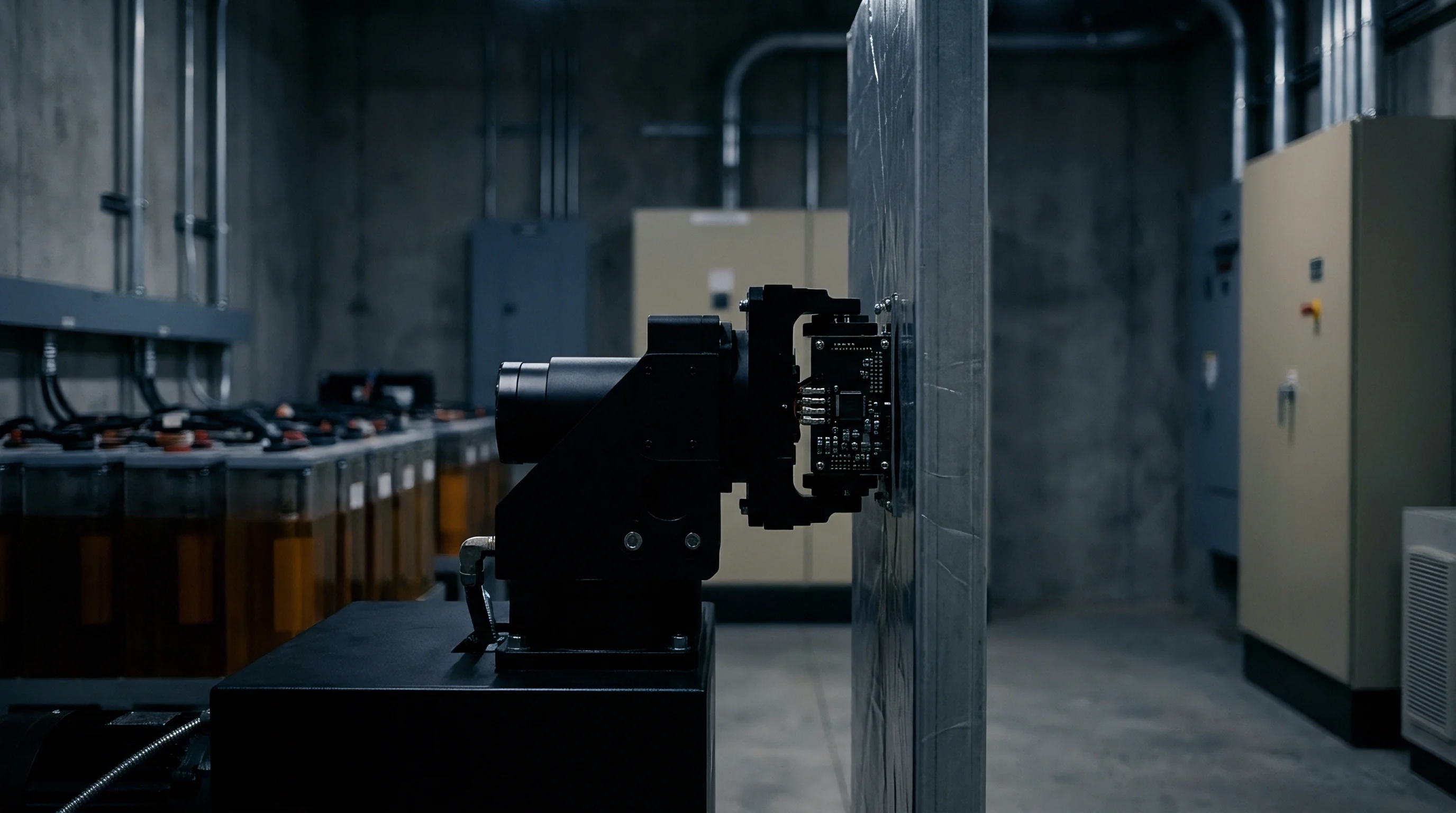
Deploying operando multi-point fiber optic sensing on a high-throughput qualification test bench requires specialized optical interrogators, environmental control chambers, and precise mechanical clamping fixtures. Operando test benches must control multi-axis mechanical constraints while delivering controllable non-uniform heat dissipation to simulate real-world module environments. Mechanical clamping plates must incorporate precision-milled optical routing grooves that prevent sensor compression damage while allowing uniform pressure transfer across active electrode areas.
Optical interrogation engines utilize high-speed swept-wavelength lasers combined with Mach-Zehnder interferometers to continuously query internal sensor networks. Interrogator hardware must deliver optical sampling frequencies high enough to capture fast thermal transients while maintaining signal stability over thousands of continuous testing hours. Data acquisition software synchronizes optical wavelength spectra with electrical cycler data, including channel voltage, current density, and electrochemical impedance spectroscopy spectra.
This multi-modal alignment ensures that mechanical micro-strain anomalies align directly with specific electrochemical operating points.

Differential Strain Deconvolution Bench Test
Operando bench testing isolates localized lithium plating using a differential strain deconvolution protocol. The test setup places a large-format pouch cell between two independently controlled liquid thermal plates. The upper plate maintains a constant twenty-five degrees Celsius while the lower plate drops to five degrees Celsius, creating a strong cross-plane thermal gradient across the cell thickness.
High-speed multi-point Rayleigh optical fibers positioned between internal layers record spatial deformation during a 4C constant-current fast-charge pulse.
Signal processing software deconvolutes raw optical backscattering signals using real-time finite-element mechanical models calibrated against baseline dummy cell data. The system isolates the pure electrochemically driven volumetric strain field by removing local thermal expansion vectors. Strain peaks appearing near the five-degree cold face signal localized lithium plating onset points within forty-five seconds of fast-charge initiation, long before external pack voltage reaches standard termination thresholds.
| Cooling Profile Config | Charge Rate (C-Rate) | Core Temp Differential | Measured Plating Onset SOC | Peak Localized Micro-Strain |
|---|---|---|---|---|
| Isothermal 25°C Baseline | 1.5 C | 0.8°C | No Plating Detected | 180 µε (Uniform) |
| Single Sided Face Cold Plate (10°C) | 3.0 C | 6.4°C | 62% SOC | 840 µε (Localized) |
| Asymmetric Tab Chill (5°C Tab / 25°C Body) | 4.0 C | 11.2°C | 41% SOC | 1420 µε (Tab Margin) |
| Dual Cold Plate Edge Chill (0°C Rim) | 4.5 C | 14.8°C | 31% SOC | 2150 µε (Edge Boundary) |

Post Mortem Verification Alignment
Validating operando optical strain signatures requires rigorous post-mortem analytical verification. Following operando differential testing, cells are transferred inside an argon-filled glovebox without thermal or mechanical shock to preserve unstable surface metallic deposits. The cell envelope is opened, and active electrodes are harvested, rinsed with dimethyl carbonate to remove residual electrolyte salts, and subjected to analytical characterization.
Scanning electron microscopy maps spatial surface morphology across zones where operando optical nodes recorded localized strain anomalies. Energy-dispersive X-ray spectroscopy and mass spectrometry titrations quantify the molar density of metallic lithium deposits relative to passivated solid-electrolyte interphase species. Spatial alignment between optical strain peak locations and post-mortem chemical plating maps confirms the resolution and spatial accuracy of the multi-node optical fiber sensor network.
Validating operando optical detection against physical material degradation requires following a strict post-test verification workflow:
- Discharging the cell down to minimum safe voltage limits under low current conditions inside controlled atmospheric gloveboxes.
- Registering optical baseline references to capture residual mechanical offsets before physical cell disassembly.
- Removing the pouch envelope and separating the electrode stack without mechanical wiping or surface contamination.
- Washing electrodes with anhydrous dimethyl carbonate to eliminate interfering fluorine electrolyte residue.
- Mapping surface topography via scanning electron microscope across coordinates designated by optical strain peak data.
- Titrating with inductively coupled plasma atomic emission spectroscopy to quantify total active metallic lithium content.
Under Clause 6.4 of standard qualification agreements, test results obtained from operando internal sensing systems override surface thermal modeling data when determining fast-charge safety margins.


Risk
Relying exclusively on standard macroscopic testing standards introduces serious commercial and safety liabilities for battery module integrators. Standard regulatory compliance frameworks, including UN 38.3 transport safety testing, IEC 62133 cell certification, and UL 2580 electric vehicle battery standards, rely on external thermal sensors, external voltage monitoring, and pack-level physical abuse tests. These regulatory standards evaluate macro-scale terminal failures, such as open flames, structural explosions, or major fluid leaks.
They fail to detect internal micro-scale degradation, including localized lithium plating, internal separator displacement, and localized thermal hot spots occurring under non-uniform cooling during aggressive operational charging.
Cells that pass standard UN 38.3 abuse tests can still harbor internal dendritic lithium deposits induced by fast charging under non-uniform cooling. Repeated fast charging causes these undetected internal dendrites to grow, eventually puncturing internal separator layers and triggering low-resistance micro-short circuits months after the pack enters commercial service. When field failure occurs, warranty claims and legal liability fall on the pack integrator who established the operational fast-charging limits.
Deploying operando multi-point fiber optic sensing provides the high-resolution empirical evidence required to set defensible fast-charging parameters that prevent hidden lithium plating degradation.

Qualification Gaps in International Standards
Current international testing protocols evaluate cells under uniform environmental conditions inside thermal chambers. Standard UN 38.3 thermal testing subjects cells to uniform temperature cycling between seventy-two degrees Celsius and minus forty degrees Celsius. These conditions do not simulate the severe localized internal thermal gradients created by modern high-power cold plate cooling systems operating under 4C fast-charging profiles.
Standard regulatory frameworks certify that a cell design will not explode under uniform ambient heating; they do not certify that a cell will avoid internal metallic lithium deposition under aggressive, thermally asymmetric fast charging.
This qualification gap exposes pack integrators to early commercial capacity loss and safety recall risks. Certified cells subjected to aggressive operational charging schedules without operando internal strain monitoring can develop dead lithium layers that reduce useful service life from two thousand cycles down to fewer than four hundred cycles. Insurance underwriters increasingly demand high-resolution operando test data to verify that fast-charging operational profiles do not induce localized plating, withholding coverage from designs that rely solely on external surface temperature monitoring.

Contractual Allocation of Fast Charge Degradation
Sourcing agreements for high-energy density cells must precisely allocate legal and financial responsibility for fast-charge degradation mechanisms. Standard supplier datasheets define cycle life guarantees under strict isothermal laboratory conditions, such as continuous 0.5C charging at twenty-five degrees Celsius. Sourcing agreements that do not explicitly define non-uniform thermal limits and operando plating thresholds allow suppliers to void performance warranties whenever cells are operated under fast-charging conditions that generate internal thermal gradients.
Integrating operando multi-point fiber optic data into commercial supply contracts establishes clear, objective criteria for warranty enforcement. Contractual clauses define specific micro-strain rate thresholds that signal the onset of localized lithium plating. If an integrator demonstrates using operando optical test data that a supplier’s cell develops internal metallic plating at declared operational charge rates under specified thermal gradients, the supplier remains liable for cell replacement and recall costs.
Establishing these verifiable internal strain metrics converts ambiguous degradation arguments into precise technical data that protects buyers from carrying unhedged warranty exposure.
Incorporating multi-point operando fiber optic metrics into early cell selection protocols shifts the commercial risk balance back toward transparency. Sourcing practices that validate cell performance under true non-uniform thermal dissipation profiles eliminate structural blind spots before committing capital to long-term manufacturing agreements.