
Thermodynamic Principles of Battery Open Circuit Voltage Profiling
Battery open circuit voltage profiling measures relaxed cell equilibrium potentials to map thermodynamic state metrics, requiring strict rest criteria.
Battery open circuit voltage profiling measures relaxed cell equilibrium potentials to map thermodynamic state metrics, requiring strict rest criteria.

Automated Kelvin probe degradation skews battery impedance metrology, requiring dynamic force control and automated contact loop monitoring to prevent false scrap.

Dynamic voltage drift screening at elevated temperature separates benign chemical decay from dangerous internal micro-shorts in received lithium cell lots.

Enforce ANSI ASQ Z1.4 Level II sampling with AQL 0.010 for critical safety flaws and Kelvin OCV IR screening to reject defective lithium cells at receiving dock.

Inbound cell receiving mandates thermal quarantine, UN 38.3 documentation verification, four-wire impedance sampling, and strict AQL defect thresholding.

Verify UN 38.3 test summaries against accredited lab databases and audit physical batch metrics at receiving to prevent demurrage and cargo seizure.

Statistical process control limits for imported prismatic cells require Cpk above 1.33 and AQL 0.065 to prevent batch failures during pack assembly.

Incoming prismatic cell sampling relies on ISO 3951-1 variable plans and ISO 2859-1 attribute plans to reject defective lots before module integration.

Verify UN 38.3 test summaries, enforce the 30% state of charge ceiling, and audit packaging specs to ensure compliant battery air freight.

Real-time fixture thermal drift compensation eliminates cell sorting errors by isolating thermomechanical trace expansion from true battery impedance shifts.

Microcalorimetric heat flow paired with differential voltage profiling separates passive chemical oxidation from active lithium loss during elevated storage.

Differentiating diffusion relaxation from chemical self-discharge requires multi-point voltage decay modeling to isolate transient overpotentials from constant Faradaic leakage.

Post-charge voltage relaxation inflection tracking reveals sub-zero metallic lithium plating before irreversible dendrite growth damages cold storage battery packs.

Dynamic thermodynamic hysteresis mapping eliminates up to six percent state of charge error across flat voltage plateaus, protecting storage project revenue.

Auditing UN 38.3 dossiers requires verifying full lab reports against 38.3.5 summaries, checking ILAC accreditation, and confirming physical cell mass tolerances.

Dynamic hysteresis state expansion in Kalman filters fixes open circuit voltage tracking errors, maintaining state of charge accuracy across flat plateau chemistries.

Mitigating state of charge drift on flat voltage plateaus combines shunt calibration, adaptive filtering, and periodic voltage knee recalibration.
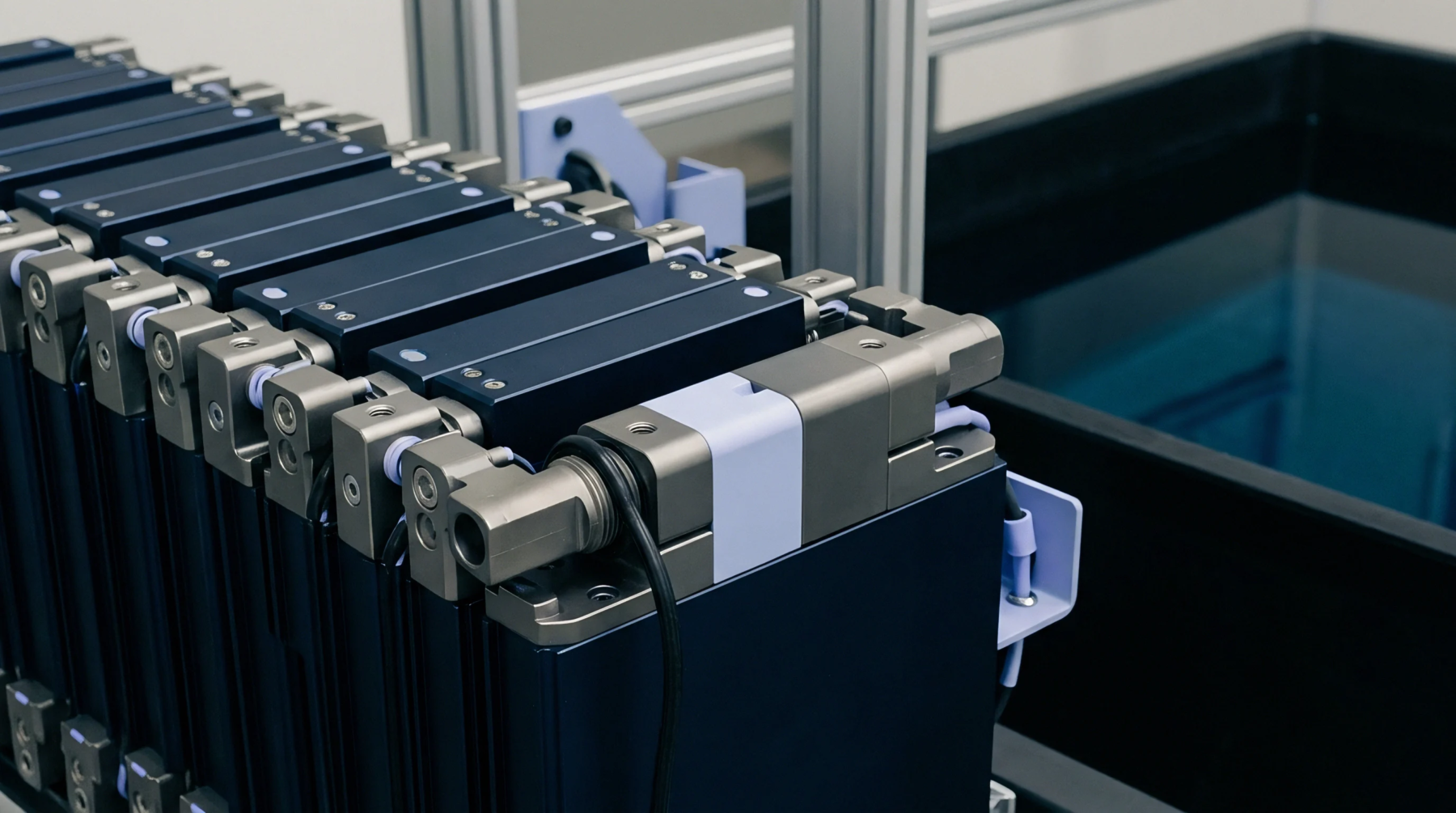
Differential voltage analysis decouples phase transition hysteresis from degradation mechanisms in lithium iron phosphate packs to ensure accurate state of charge calibration.

Verify air cargo cell charge limits below 30 percent using rested open-circuit voltage lookups or bench discharges backed by signed UN 38.3 test records.

Precision state of charge settings and active reefer climate control prevent capacity loss and internal resistance growth during oceanic container transit.

Differential capacity peak tracking isolates phase slippage and plating to detect non-linear capacity knees hundreds of cycles before bulk retention fails.

Augmenting filter state vectors with differential hysteresis operators resolves LFP voltage plateau ambiguity and eliminates conservative 15% capacity buffering.

Subtracting thermo-galvanic voltage offsets from post-pulse relaxation telemetry prevents state-of-charge drift and protects battery warranty diagnostics.

Calibrating reduced order particle observers optimizes usable cell capacity and fast charging rates while preventing lithium plating through precise surface state tracking.

Validating ISO 17025 lab schedules and continuous cell batch traceability prevents air transport cargo rejection and shifts regulatory liability to suppliers.

LFP open circuit voltage settling requires at least 14 days post-charge to distinguish structural phase equilibrium from latent micro-short decay.

Differential capacity analysis transforms flat LFP voltage plateaus into distinct peak signatures to quantify lithium loss and electrode decay non-destructively.

Sub-pack integrators absorb full unmitigated thermal runaway losses unless contracts define containment metrics and carve out propagative fire liabilities.
Extended electrochemical relaxation time constants induce residual overpotential that corrupts zero-point Coulomb counting calibration in battery packs.

Receiving screening of stored prismatic lithium lots requires thermal stabilization, sub-millivolt OCV drift tracking, and clamped DCIR metrology to catch self-discharge and swelling defects.
Expertise is a utility, not a secret. sentiention™ publishes its working knowledge as open reference: intelligence layer covering the materials it sources, the markets it enters, and the reference that serves both.