
State of Charge Drift Mitigation in Commercial Energy Storage Packs Operating on Flat Voltage Plateaus
Mitigating state of charge drift on flat voltage plateaus combines shunt calibration, adaptive filtering, and periodic voltage knee recalibration.
Mitigating state of charge drift on flat voltage plateaus combines shunt calibration, adaptive filtering, and periodic voltage knee recalibration.
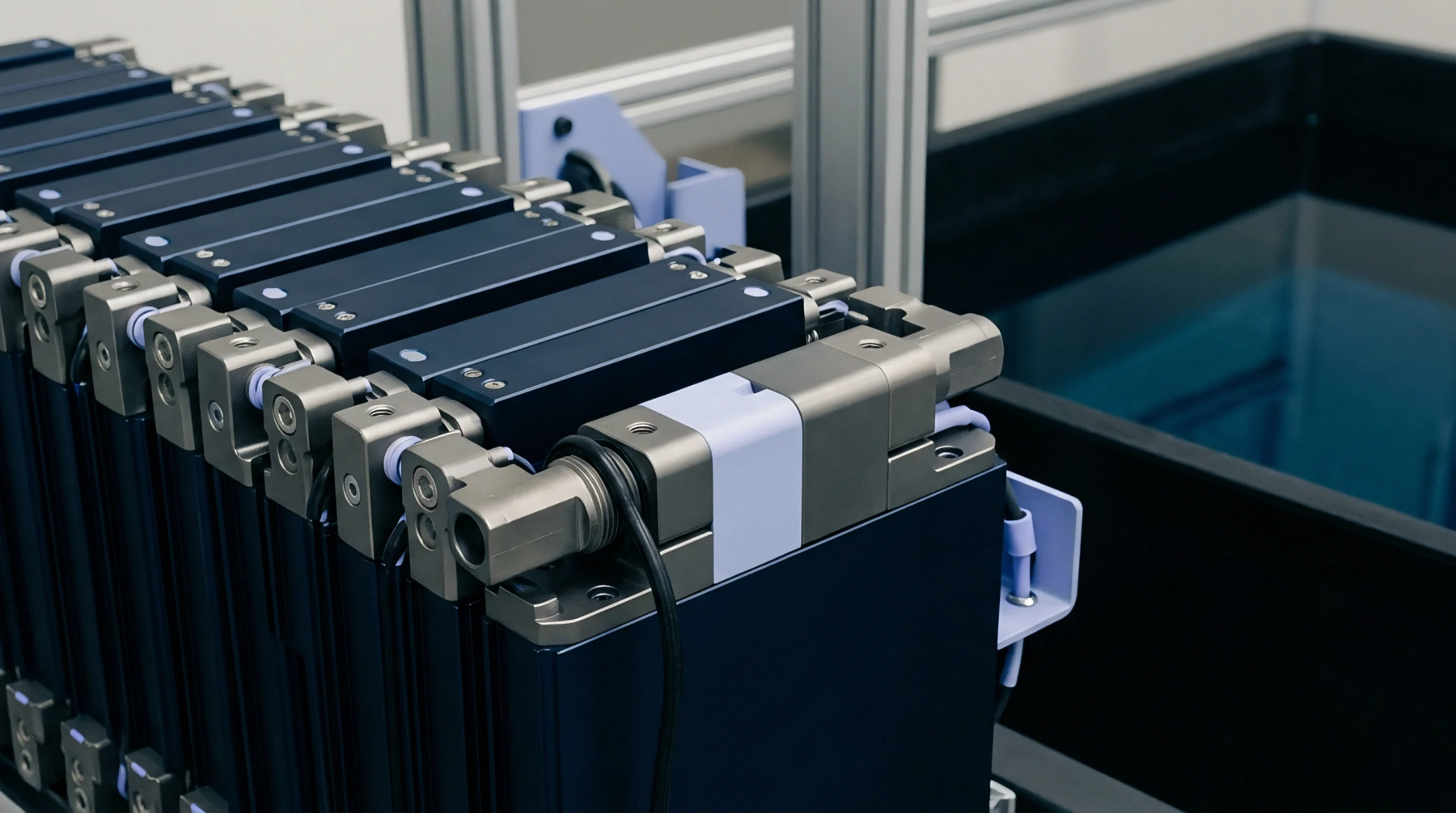
Differential voltage analysis decouples phase transition hysteresis from degradation mechanisms in lithium iron phosphate packs to ensure accurate state of charge calibration.

Lithium iron phosphate open circuit voltage equilibrium maps two-phase hysteresis using multi-hour relaxation testing for state of charge estimation

Reversible lithium stripping under cold operation requires voltage relaxation or dQ/dV diagnostic tracking to adjust BMS derating and protect cycle life.

Subzero charging forces graphite anode potential below zero volts against lithium, driving metallic plating over intercalation and causing rapid battery capacity loss.

Subzero fast charging induces metallic lithium plating detectable via mid-frequency impedance arc splitting and phase angle drops near zero degrees.

Sub-zero thermal qualification requires precise soak verification, active heating uniformity controls, and three-electrode plating boundary detection.

Evaluating subzero cell capacity requires measuring charge transfer resistance and verifying thermal equilibration before accepting supplier datasheet claims.

Cathode particle fracture increases specific surface area while fragmented debris clogs electrode void pathways, causing sharp non-linear impedance rise.

Differential capacity peak tracking isolates phase slippage and plating to detect non-linear capacity knees hundreds of cycles before bulk retention fails.

Quantifying solid electrolyte interphase growth and lithium plating thresholds requires parsing passivating solvent consumption from kinetic overpotentials.

Differential capacity analysis detects cell degradation early by tracking microvolt phase shifts and peak areas under low C-rate charging.

Nickel dissolution in high-nickel cells causes anode passivation breakdown, accelerating lithium plating and demanding contractual upper cutoff voltage caps.
High precision coulometry and differential voltage analysis isolate solid interphase formation kinetics and active lithium consumption in lithium cells.

Silicon anode cells suffer 10 to 25 percent energy efficiency losses from stress-coupled thermodynamic hysteresis unrecoverable by rate reduction.

Phase control above 70 mV suppresses c-Li15Si4 nucleation, trading initial capacity for extended cycle life and reduced hysteresis loss in silicon anodes.

Augmenting filter state vectors with differential hysteresis operators resolves LFP voltage plateau ambiguity and eliminates conservative 15% capacity buffering.

Accurate iron phosphate state of charge tracking relies on temperature compensated open circuit voltage hysteresis mapping measured after four hour rest periods.

Active pressure vacuum degassing during cell formation eliminates trapped gas voids in high capacity sodium electrodes to prevent local salt depletion and plating.

Cryptographic ledgers validate cold chain battery telemetry via edge hashing, zero-knowledge proofs, and automated smart contract escrow claims

Subzero battery warranty validation requires compact CAN FD payload packing of cell voltage differentials and temperature rates to prove lithium plating limits.
Contractual impedance guarantees depend on ten-second DC resistance metrics, bridging microstructural interphase degradation models to commercial warranty enforcement.

Combining high-frequency impedance metrics with dQ/dV peak shifting catches early cell resistance variations before cycling degradation becomes visible.

Solid phase hysteresis requires state space BMS modeling and GITT quantification to prevent severe state of charge errors and uncompensated efficiency loss.

Calibrating reduced order particle observers optimizes usable cell capacity and fast charging rates while preventing lithium plating through precise surface state tracking.

Unrelaxed solid-phase diffusion gradients create particle surface overpotentials that distort battery open-circuit voltage lookups by up to twenty percent.

LFP open circuit voltage settling requires at least 14 days post-charge to distinguish structural phase equilibrium from latent micro-short decay.

Sub-zero sodium storage depends on balancing slope intercalation kinetics against closed-pore clustering while maintaining overpotential above metallic plating.

Pyrolysis between 1100C and 1300C balances turbostratic interlayer spacing with closed pore volume to maximize plateau capacity while capping irreversible SEI losses.

Precursor selection for sodium ion hard carbon anodes dictates closed pore volume, surface area, initial coulombic efficiency, and landed material cost.
Expertise is a utility, not a secret. sentiention™ publishes its working knowledge as open reference: intelligence layer covering the materials it sources, the markets it enters, and the reference that serves both.